‘2026 SEO strategy guide’ The search landscape has undergone a seismic shift. If you are still following the playbook from 2024 or even early 2025, your rankings are likely in jeopardy. Following the December 2025 Google Core Update, the rules of engagement have been rewritten.
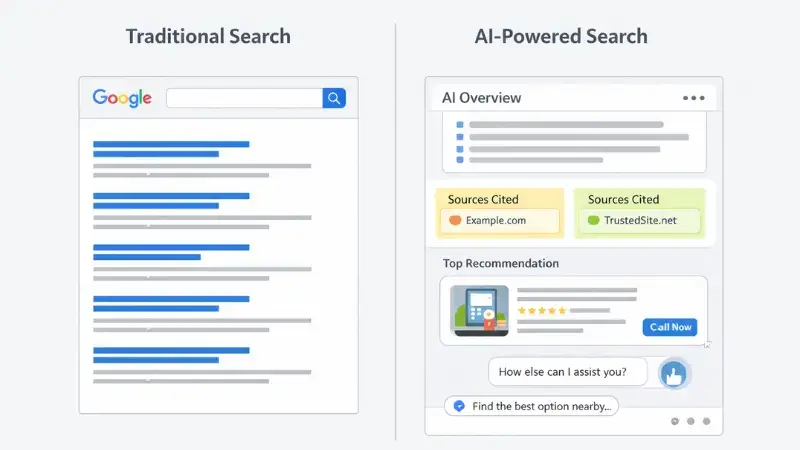
Search is no longer just a list of blue links; it is an interactive, AI-driven ecosystem where user satisfaction, brand authority, and technical precision are the only currencies that matter. In this comprehensive 2026 SEO strategy guide, we will break down the four pillars of modern search success. From mastering Local SEO to optimizing for Large Language Models (LLMs), this is your roadmap to visibility in the age of AI.
The New Reality of Search in 2026
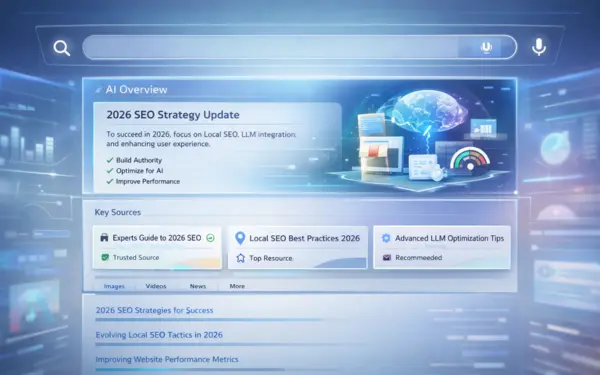
1. The core update in December 2025 was the final blow for “SEO-first” content. Google’s algorithms have reached a level of sophistication where they can now distinguish between content written to please an algorithm and content created to solve a human problem. We have entered the era of Search Generative Experience (SGE) and AI Overviews (AIO), where being “number one” on a page is often less important than being the “cited source” in an AI-generated summary.
For any business looking to build a robust SEO strategy 2026 Guide, the focus must shift from chasing keywords to building a Digital Knowledge Graph. This means your brand must be recognized as a trusted authority by both human users and AI agents like Gemini, GPT-5, and Perplexity.
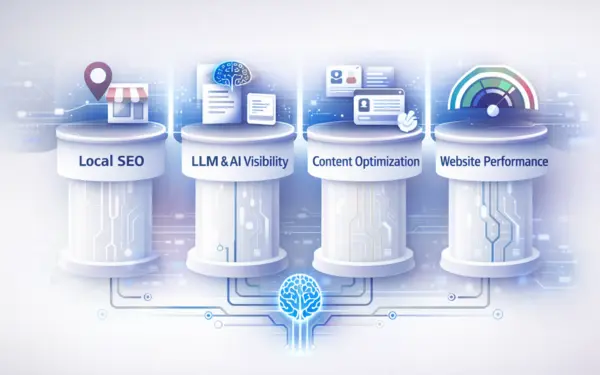
2026 SEO Strategy Guide main The Four Pillars of 2026 SEO
Local SEO 2026: Moving beyond citations to real-world engagement and “Micro-SEO.”
LLMs and AI: Optimizing for visibility within AI summaries and conversational search.
Content Optimization 2026: Prioritizing “Experience” in EEAT and solving the “Zero-Click” challenge.
Website Performance SEO 2026: Mastering the new Interaction to Next Paint (INP) and AI-ready technical standards.
By the end of this guide, you will understand how to integrate these elements into a cohesive plan that drives not just traffic, but high-intent conversions.
The Evolving SEO Landscape in 2026
The primary driver of change in 2026 is the maturity of Generative AI in search. Google’s AI Overviews now occupy the “Position Zero” for over 80% of informational queries. This has led to a significant increase in zero-click searches, where users find their answers directly on the SERP (Search Engine Results Page).
Key Trends Post-December 2025
EEAT Dominance: Trustworthiness is now the weighted heaviest. Google is actively de-indexing “AI slop”—mass-produced, unedited AI content that lacks original insight.
Branded Search Focus: As AI summaries dominate, having a strong brand presence is the only way to ensure users seek you out directly.
Multi-Modal Search: Users are increasingly searching via Google Lens (visual) and Voice, requiring a strategy that optimizes images, videos, and conversational text.
Mastering Local SEO Strategies for 2026
Local search has become highly conversational. In 2026, users don’t just type “plumber near me”; they ask their AI assistant, “Who is the most reliable plumber available right now for an emergency leak in [Neighborhood]?”
Optimizing Google Business Profile (GBP)
Your GBP is your local storefront. Static information is no longer enough.
Freshness is King: Google now rewards profiles with weekly updates. This includes new photos (360° views are a plus), localized posts, and updated “In-Stock” product feeds.
Video Integration: Upload short, “behind-the-scenes” videos. Authentic, non-professional video content increases engagement scores, which Google uses as a ranking signal.
Building Review Engines and Reputation Management
In 2026, the quality of reviews outweighs the quantity.
Keyword-Rich Reviews: Encourage customers to mention specific services and locations (e.g., “Great water heater repair in Downtown Austin”).
Response Speed: AI now tracks how quickly you respond to reviews and messages. Aim for a response time under 4 hours to maintain “High Responsiveness” badges.
Local Citations and Structured Data
Traditional citations are still relevant, but Local Business Schema is the new priority. You must use JSON-LD markup to tell Google exactly what services you offer, your pricing tiers, and your service area boundaries.
Voice Search and Mobile-First Local Optimization
Ensure your site answers “Who,” “What,” and “Where” questions concisely. Most local searches occur on mobile devices or through smart speakers. Use natural language that reflects how people talk in your specific region.
Micro-SEO for AI Local Overviews
AI Overviews for local intent often pull from niche forums and local directories. To appear here, ensure your business is mentioned in local news, community Reddit threads, and neighborhood-specific blogs.
Leveraging LLMs and AI in Your SEO Strategy 2026
If you aren’t optimizing for LLMs SEO 2026, you are missing a massive portion of the market. AI models like ChatGPT, Gemini, and Claude are becoming the first stop for product research.
Understanding LLM Optimization (GEO vs. SEO)
Generative Engine Optimization (GEO) focuses on becoming a cited source.
Citations are the new Backlinks: LLMs prioritize sources that are frequently mentioned across trusted domains.
Brand Sentiment: AI models analyse the sentiment of mentions. Negative press on Reddit or Trustpilot can prevent an AI from recommending your brand.
Building Authority for AI Visibility
To be seen by AI, you must be a “Trusted Entity.”
Original Data: Publish proprietary research, surveys, or case studies. AI models love citing unique data points that aren’t available elsewhere.
llms.txt: Implement an llms.txt file in your root directory to provide a machine-readable summary of your site’s most authoritative content for AI crawlers.
Hybrid Human + AI Content Creation
The winning formula for SEO strategy 2026 is “AI-Assisted, Human-Perfected.” Use AI to outline and research, but ensure a subject matter expert (SME) adds the “Experience” layer—personal anecdotes, professional opinions, and unique perspectives that an AI cannot replicate.
Advanced Content Optimization Techniques for 2026
Content in 2026 must be Experience-First. Google’s “E” for “Experience” in EEAT is now the primary filter for high-value rankings.
EEAT Implementation
Author Credentials: Every piece of content needs a verified author bio with links to social profiles and professional certifications.
Fact-Checking: After the December 2025 update, even minor factual errors can lead to a site-wide trust penalty.
Topic Clusters and Semantic SEO
Stop targeting single keywords. Build Topic Hubs that cover a subject from every angle.
Pillar Page: High-level overview of a broad topic.
Cluster Content: Deep dives into specific sub-topics, all interlinked with descriptive anchor text
Answer-First Content for AI and Zero-Click
Structure your content to provide the answer in the first 100 words. Use the Inverted Pyramid style of journalism. This increases your chances of being featured in AI Overviews and Featured Snippets.
Table: Content Optimization Checklist 2026
| Element | Requirement | Why it Matters |
| User Intent | Information, Commercial, or Navigational | Matches content to the user’s journey stage. |
| Schema Markup | Article, FAQ, and Product Schema | Helps AI and Google parse data accurately. |
| Semantic Density | LSI keywords and natural synonyms | Improves relevance for LLM retrieval. |
| Multimedia | 1 Video + 2 Images per 1000 words | Boosts time-on-page and visual search visibility. |
Website Performance and Core Web Vitals Optimization in 2026
Technical SEO is no longer a “one-and-done” task. It is a continuous requirement for maintaining visibility.
Current Core Web Vitals (CWV) Metrics
In 2026, Interaction to Next Paint (INP) has replaced First Input Delay (FID) as the most critical responsiveness metric.
LCP (Largest Contentful Paint): Target < 2.5s.
INP (Interaction to Next Paint): Target < 200ms.
CLS (Cumulative Layout Shift): Target < 0.1.
Technical Optimizations for 2026
Next-Gen Formats: Use AVIF for images and WebM for video.
Server-Side Rendering (SSR): Essential for JavaScript-heavy sites to ensure AI crawlers can “read” the content instantly.
Edge Delivery: Use CDNs (like Cloudflare or Akamai) to serve content from the server closest to the user, minimizing latency.
Comparison Table: Top SEO Tools for 2026 Strategies
| Tool | Primary Use Case | Best Feature for 2026 |
| Ahrefs | Backlink & Keyword Research | Brand Radar (Track LLM mentions) |
| Semrush | Competitive Analysis | AI Overview Tracker (AIO visibility) |
| Google Search Console | Performance Monitoring | INP Debugging Reports |
| Screaming Frog | Technical Auditing | LLM Crawler Simulations |
| Surfer SEO | Content Optimization | Semantic Intelligence |
| BrightLocal | Local SEO | GBP Freshness Monitor |
| PageSpeed Insights | Performance | Real-world User Experience Data |
| Perplexity AI | LLM Research | Citation Source Analysis |
Integrating All Four Pillars into a Cohesive SEO Strategy 2026
A successful SEO strategy 2026 is not a series of isolated tasks; it is an integrated machine.
Research: Use LLMs to find content gaps.
Create: Build EEAT-driven content that answers local and global queries.
Optimize: Ensure the technical foundation is flawless (CWV).
Promote: Build brand authority through digital PR and community engagement.
Future SEO Trends Beyond 2026
As we look past 2026, expect Agentic SEO. AI agents will not just search for information; they will perform tasks (like booking a flight or buying a product). Your website must be optimized for “Machine Ingestion”—meaning your data must be structured perfectly for AI to take action on behalf of the user.
Conclusion
Mastering your SEO strategy 2026 requires a fundamental shift in mindset. You are no longer optimizing for a search engine; you are optimizing for trust, speed, and helpfulness. By focusing on the four pillars—Local SEO, LLM visibility, high-value content optimization, and technical performance—you will not only survive the volatility of the December 2025 Core Update but thrive in the new search economy.
Next Step: Are you ready to see how your site stacks up?
I can perform a preliminary 2026 SEO audit for your domain—would you like me to start by analyzing your current Core Web Vitals or your LLM visibility?
FAQ: Frequently Asked Questions about 2026 SEO
What is the best SEO strategy for 2026?
The best strategy is a hybrid approach focusing on Topical Authority and Brand Recognition. Ensure your content provides unique value (EEAT) and is technically optimized for INP and AI Overviews.
How do LLMs affect SEO in 2026? LLMs act as “gatekeepers.” They summarize web content for users. To stay relevant, your brand must be a “cited source” within these summaries, which requires high authority and structured data.
Why is local SEO more important in 2026?
As global search becomes more crowded with AI content, local search remains the most reliable way for physical businesses to capture high-intent customers who are ready to buy immediately.
How to improve Core Web Vitals for better rankings?
Focus on Interaction to Next Paint (INP) by reducing heavy JavaScript, optimizing image formats to AVIF, and using high-quality hosting with edge caching.
What was the impact of the December 2025 Core Update?
It significantly penalized “thin” content and rewarded sites that showed clear evidence of firsthand experience and high user satisfaction scores