
In 2026, building a startup without a clear digital growth engine is no longer a calculated risk—it’s a structural disadvantage. The post-cookie era has fully arrived, AI-driven personalization is now expected, and the cost of paid acquisition continues to rise across nearly every major platform.
In this environment, working with a digital marketing agency for startups is no longer just an operational decision; it’s a strategic one. Startups that succeed today aren’t simply launching good products—they’re mastering visibility, demand, and momentum from day one.
What makes this moment uniquely challenging is the speed at which startups are expected to prove traction. Investors want evidence of scalable growth earlier, customers expect seamless and personalized experiences, and platforms evolve faster than most internal teams can adapt.
Founders often try to manage growth internally, only to discover that fragmented execution leads to wasted spend and unclear results. This is precisely where a specialized digital marketing agency for startups creates leverage—bringing structure, focus, and experience into an otherwise chaotic phase of growth.
Startup digital marketing has also matured beyond isolated tactics or short-term hacks. Sustainable growth now comes from interconnected systems: SEO that compounds over time, performance marketing grounded in real attribution, content that builds trust before conversion, and lifecycle automation that increases lifetime value.
These systems require not only tools, but judgment—knowing what to prioritize, what to ignore, and when to scale. That level of clarity is difficult to achieve without partners who have seen multiple growth cycles before.
This article is designed to give founders exactly that clarity. We’ll explore why many startups struggle with in-house marketing in 2026, the key digital marketing trends shaping early-stage growth, and the proven strategies that consistently deliver measurable ROI. You’ll also see real-world case studies, practical KPIs, and a clear framework for choosing the right digital marketing agency for startups—one aligned with your stage, your market, and your long-term ambitions.
Why Most Startups Fail at In-House Digital Marketing in 2026
The dream of the “all-in-one” marketing manager is effectively dead. In 2026, the sheer breadth of skills required to execute a competitive strategy—ranging from technical SEO and data science to high-fidelity video production—makes it impossible for a single hire (or even a small team) to keep pace.
The Expertise Gap and the “Generalist Trap”
Most startups begin by hiring a generalist. While this person might be a “Swiss Army knife” of marketing, they often lack the depth required for high-performance channels. Can they write a blog post? Sure. But can they optimize it for Answer Engine Optimization (AEO) so it surfaces in ChatGPT or Google’s AI Overviews? Probably not. An agency brings a pod of experts: a dedicated strategist, a performance buyer, a technical SEO lead, and a creative director. This “pod” model ensures that every dollar spent is backed by specialized knowledge.
The Privacy Wall: Death of Cookies and Rising CPMs
The level of technical expertise required to succeed has never been higher. With the full deprecation of third-party cookies, startups can no longer rely on the Facebook Pixel to find their audience with pinpoint accuracy.
- Rising CPMs: Ad costs on Meta and Google have surged as competition for limited, high-intent audiences intensifies.
- Attribution Chaos: Without professional-grade modeling, it’s nearly impossible to know which touchpoint actually led to a conversion.
- Data Privacy Compliance: Navigating the global maze of GDPR, CCPA, and new 2026 privacy laws requires more than just a “cookie banner”—it requires a first-party data strategy that most startups aren’t equipped to build in-house.
Scaling Challenges and Opportunity Cost
Startups are characterized by their need for speed. When marketing is handled in-house, scaling often involves a slow, painful hiring process. An agency, however, offers instant scalability. If a campaign is working, they have the bandwidth to double the spend and the creative output overnight. Conversely, if you need to pivot—a common occurrence in the startup world—an agency allows you to shift resources from one channel to another without the friction of layoffs or retraining.
The Biggest Digital Marketing Trends Shaping Startups in 2026
The marketing playbook has been rewritten. According to recent 2026 reports from Gartner and HubSpot, the focus has shifted from “discovery” to “curation.” Users don’t want to find products; they want the right products to find them.
AI-Powered Personalization and Predictive Analytics
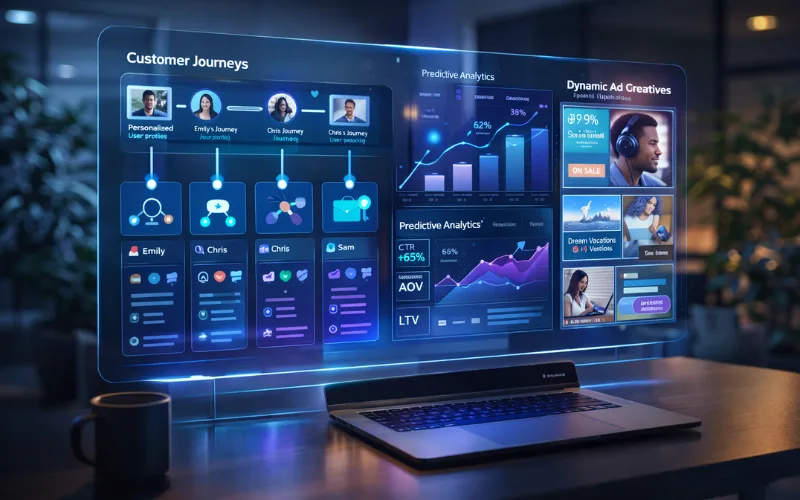
AI has moved from a novelty for writing captions to the “operating system” of the modern marketing stack. Agencies now use tools like Google Flow or Albert.ai to predict which campaign creatives will perform best before a single cent is spent. This predictive layer allows a digital marketing agency for startups to bypass the “guesswork” phase that typically drains early budgets.
Zero-Party Data and First-Party Strategies
In a world without cookies, your own data is your only “moat.” Successful startups in 2026 are obsessed with Zero-Party Data—information that customers proactively share through quizzes, surveys, and interactive tools. Platforms like Klaviyo and Typeform are being integrated into complex automation funnels to build deep profiles of users, allowing for hyper-personalized email and SMS campaigns that convert at 3x the rate of generic broadcasts.
Short-Form Video Dominance and Video-Commerce
Short-form video is no longer just for Gen Z; it is the primary search engine for the under-30 demographic.
- TikTok and YouTube Shorts: These are now “top of funnel” giants where discovery happens.
- Live Commerce: Inspired by the massive success of brands in Asia, Western startups are increasingly using live-streamed shopping events to drive instant revenue.
- AI Video Production: Tools like Sora and HeyGen have slashed the cost of video production, allowing startups to produce 20+ variations of an ad for the price of one traditional shoot.
Voice Search and Conversational Marketing
“Search” is becoming a conversation. With the rise of AI assistants, more users are asking questions like “What is the best CRM for a Series A fintech startup?” instead of typing keywords. This has birthed Generative Engine Optimization (GEO). Your content must now be structured to provide direct, authoritative answers that AI agents can easily cite.
Image suggestion: A flowchart showing how a single piece of “hero” content (like a webinar) is broken down into AI-generated clips, blog posts, and voice search answers
Proven Digital Marketing Strategies That Deliver Real Results for Startups
Growth doesn’t happen by accident; it’s the result of a coordinated multi-channel approach. Here is how a top-tier digital marketing agency for startups architects a winning strategy in 2026.
Search Engine Optimization (SEO) for Long-Term Growth
SEO in 2026 is about Topic Authority, not keyword density.
- The Strategy: Instead of 50 thin blog posts, agencies focus on “Pillar Pages”—comprehensive, 3,000-word guides that cover every facet of a topic.
- Technical SEO: Ensuring your site is “crawlable” for both Google bots and AI agents. This includes implementing advanced Schema markup and ensuring lightning-fast load times (Core Web Vitals are now a non-negotiable).
- Tools: Ahrefs, SEMrush, and Surfer SEO for content optimization.
- Budget: Expect to invest $3,000 – $7,000/month. SEO is a long-game, but the compounding ROI eventually brings your CAC down to nearly zero.

Pay-Per-Click (PPC) and Performance Marketing
Paid media is the “fuel” that gets your engine started.
- Google Ads: Focus on “high-intent” search terms. In 2026, we lean heavily on Smart Bidding and Performance Max campaigns, but with strict exclusions to avoid wasted spend on “junk” traffic.
- Meta Ads: Creative is the new targeting. Since we can’t track users as precisely, our ad creative (videos and images) must do the heavy lifting of attracting the right audience.
- Tools:Meta Ads Manager, Google Ads, and AdCreative.ai for rapid testing.
- Budget: For seed-stage startups, a minimum of $2,500 – $5,000/month in ad spend is usually required to gather meaningful data.
Content Marketing and Thought Leadership
If SEO is the “bones,” content is the “soul.” Startups like Stripe and Notion didn’t just build products; they built movements through content.
- The “Human” Element: In an AI-saturated world, authentic, human-led content stands out. This includes founder-led LinkedIn posts, deep-dive industry reports, and community-driven newsletters.
- Repurposing: One “hero” piece of content (like a podcast) should be sliced into 10 TikToks, 5 LinkedIn posts, and 2 SEO articles.
Social Media Marketing and Community Building
Stop posting “at” your audience and start building “with” them.
- Platform Choice: B2B startups should double down on LinkedIn and X (Twitter), while B2C/DTC brands thrive on Instagram and TikTok.
- Creator Partnerships: Instead of one-off “influencer” posts, 2026 is about long-term Co-Creation. Partner with niche creators to build limited-edition features or content series.
Email Marketing and Automation Funnels
Email remains the highest-ROI channel (averaging $36 for every $1 spent).
- The Strategy: Build “Lifestyle Flows” that go beyond the “Welcome Series.” Use behavioral triggers—like if a user views a pricing page three times but doesn’t buy—to send a personalized video testimonial or a limited-time offer.
- Tools: Klaviyo for E-commerce; HubSpot or Customer.io for Saas.
Conversion Rate Optimization (CRO)
Driving traffic is useless if your website is a “leaky bucket.”
- The Strategy: Use heatmaps (like Hotjar or FullStory) to see where users are dropping off. A digital marketing agency for startups will run A/B tests on your headlines, CTAs, and checkout flows.
- Result: Improving your conversion rate from 1% to 2% effectively doubles your revenue without spending an extra cent on ads.
Real Case Studies: How a Digital Marketing Agency for Startups Drove Explosive Growth
Nothing speaks louder than results. Let’s look at how these strategies played out for global leaders and a modern 2025-2026 example.

1. Duolingo: The Power of Gamified Retention
Duolingo is the gold standard for Product-Led Growth (PLG). Their agency-supported strategy focused on “Meme Marketing” and aggressive social engagement.
- The Strategy: They leaned into the “unhinged” persona of Duo the Owl on TikTok, driving massive organic awareness among Gen Z.
- The Result: By mid-2025, Duolingo hit over 125 million monthly active users. More impressively, 80% of their growth is organic, proving that a strong brand voice can significantly lower CAC.
2. Figma: Community as a Moat
Figma’s growth was driven by becoming the “operating system” for designers.
- The Strategy: Their marketing team focused on “Template Marketing” and fostering a robust community library where users could share their own designs. This created a powerful network effect.
- The Result: A dominant market share in the design space and a legendary multi-billion dollar valuation, fueled by word-of-mouth and high-authority SEO.
3. Brex: High-Intent Account-Based Marketing (ABM)
Brex revolutionized fintech for startups by targeting founders where they spend their time.
- The Strategy: A mix of high-intent Google Ads and aggressive outdoor advertising (billboards in tech hubs) created a sense of omnipresence.
- The Result: Rapid acquisition of Y-Combinator startups, leading to a massive MRR increase within its first 24 months.
4. Anonymized 2025 Case Study: The “Green-Tech” Pivot
A Series A sustainable packaging startup partnered with a growth agency in late 2025.
- The Problem: High CAC on Instagram and low brand trust.
- The Solution: By moving 40% of the budget into Digital PR and LinkedIn thought leadership, the agency successfully elevated the founder’s profile as a sustainability expert. They also implemented server-side tracking to recover “lost” attribution data.
- The Result: Within 6 months, they saw a 45% reduction in CAC and a 300% increase in inbound B2B inquiries.
How to Choose the Right Digital Marketing Agency for Startups

The “best” agency isn’t the one with the biggest office; it’s the one that acts as an extension of your team. Here is how to vet your potential partners.
Red Flags to Avoid
- Guaranteed Rankings: If an agency promises “Number 1 on Google in 30 days,” walk away. No one controls Google’s algorithm.
- Lack of Transparency: You should own all your accounts (Meta, Google Ads, GA4). If an agency refuses to give you “Admin” access, they are holding your data hostage.
- “Set it and Forget it” Mentality: Startup marketing requires constant iteration. If they only report once a month, they aren’t moving fast enough.
- AI-Only Content: If their “strategy” is just pumping out 100 AI-written articles a week, your brand will eventually be penalized by search engines and ignored by humans.
Must-Have Qualities
- Startup DNA: Have they worked with companies at your stage? Scaling a Seed-stage company is vastly different from managing a Fortune 500 brand.
- Performance-Based Mentality: They should be obsessed with ROI, CAC, and LTV, not just “impressions” or “likes.”
- Agility: Can they pivot a campaign in 48 hours?
- Transparent Reporting: You need a real-time dashboard (like Looker Studio) that connects your ad spend directly to your CRM revenue.
Questions to Ask in the Pitch
- “How will you handle the loss of third-party cookies in our ad accounts?”
- “What is your process for testing new creative hooks every week?”
- “Can you show us a case study where you successfully lowered CAC for a B2B SaaS company?”
- “Who will be our day-to-day point of contact—a senior strategist or a junior account manager?”
Budget Guidelines for 2026
- Seed Stage: Focus on validation. Budget $5,000 – $10,000/month (including agency fees and ad spend).
- Series A: Focus on scaling. Budget $15,000 – $50,000+/month. At this stage, you should be aiming for a 3:1 LTV to CAC ratio.
Measuring Success: KPIs Every Startup Should Track in 2026
If you can’t measure it, you can’t improve it. Move beyond vanity metrics and focus on the “North Star” numbers.
| Metric | Why It Matters in 2026 | Target Benchmark |
| Customer Acquisition Cost (CAC) | The total cost to acquire one customer. | Should be < 33% of LTV. |
| Lifetime Value (LTV) | Total revenue expected from a single user. | Higher is better; focus on retention. |
| ROAS (Return on Ad Spend) | Revenue generated per dollar of ad spend. | 3.5x – 5x is healthy. |
| MQL to SQL Conversion | Measures the quality of the leads you are getting. | 20% – 35% for B2B. |
| Blended CAC | Total Marketing Spend / Total New Customers. | Accounts for “halo effects” of brand ads. |
The Challenge of Attribution
In 2026, “Last-Click Attribution” is a lie. A customer might see a TikTok, read a LinkedIn post, search on Google, and finally click an email before buying. A sophisticated digital marketing agency for startups will use Marketing Mix Modeling (MMM) to understand how all these channels work together.
Conclusion
The digital landscape of 2026 is unforgiving to the unprepared, yet it offers unprecedented opportunities for those who can harness the power of AI, first-party data, and authentic storytelling. As we’ve explored, the “DIY” era of startup marketing has evolved into a highly technical discipline that requires specialized expertise and a relentless focus on ROI. Whether it’s navigating the complexities of a cookieless world, mastering the nuances of “Answer Engine Optimization,” or building a community that acts as a defensive moat, the stakes have never been higher.
Partnering with a dedicated digital marketing agency for startups isn’t just about outsourcing tasks; it’s about acquiring a strategic engine that can propel your company from Seed to Series A and beyond. The right agency doesn’t just deliver clicks—they deliver a scalable system for predictable revenue. They allow you, the founder, to return to your core mission: building a product that changes the world, while they handle the complex machinery of growth.
As you evaluate your current marketing efforts, ask yourself: Is your growth strategy built for the realities of 2026, or are you still running a 2022 playbook? If you find yourself struggling with rising acquisition costs or stagnant conversion rates, it might be time to bring in the experts. The difference between a startup that fades away and one that becomes a household name often comes down to the quality of the digital strategy they execute today.
Frequently Asked Questions (FAQs)
1. Why should a startup hire a specialized digital marketing agency instead of a generalist one?
Startups operate under unique constraints—limited budgets, the need for rapid validation, and high growth expectations. A specialized digital marketing agency for startups understands the “growth hacking” mindset. Unlike large-scale generalist agencies that focus on brand awareness for established corporations, startup-focused agencies prioritize agility, lean testing, and direct ROI to ensure your seed funding is utilized efficiently.
2. What is the typical cost of hiring a digital marketing agency for startups in 2026?
In 2026, costs vary based on the scope of work. Most agencies offer tiered pricing:
- Seed Stage: $3,000 – $7,000 per month for core services like SEO and PPC management.
- Series A & Beyond: $10,000 – $25,000+ per month for full-funnel strategies, including content production, high-end video, and advanced data analytics. The goal is always to maintain a healthy LTV:CAC ratio while scaling.
3. How long does it take to see real results from digital marketing?
Results vary by channel. PPC and Performance Marketing can drive traffic and leads within days. However, Search Engine Optimization (SEO) and brand building typically take 4 to 6 months to show significant organic momentum. A professional agency will provide a “balanced scorecard,” combining quick wins from paid media with the long-term compounding benefits of organic growth.
4. How do agencies handle data privacy and the “cookie-less” landscape in 2026?
Top-tier agencies now implement First-Party Data strategies and Server-Side GTM (Google Tag Manager). By helping startups build their own databases through lead magnets, interactive quizzes, and community platforms, an agency ensures that your marketing remains effective and compliant with global privacy laws like GDPR and CCPA, even without third-party tracking cookies.
5. Can a digital marketing agency help with Product-Led Growth (PLG)?
Absolutely. In 2026, the line between product and marketing is blurred. An agency can help optimize your onboarding flows, set up in-app trigger emails, and create “viral loops” that encourage current users to invite others, effectively turning your product into its own most powerful marketing channel.
You can share your thoughts by filling out this form.