
It’s early 2026, and if you feel like the world is being rewritten by artificial intelligence, you’re not imagining it. From the medical diagnostics at your local clinic to the creative tools on your phone, AI is everywhere. But here’s the secret that most people—even some techies—don’t fully grasp: behind every “smart” AI is a massive army of humans teaching it how to think.
This is the world of AI data annotation, and in 2026, it has officially evolved from a side hustle into a legitimate, high-paying career path for U.S. freelancers.
So, what exactly is AI data annotation? In simple terms, it’s the process of labelling data—text, images, video, or audio—so that machine learning models can understand it. When you tell an AI that a specific paragraph is “sarcastic” or you correct a line of code it generated, you are annotating. Because the demand for “Human-in-the-Loop” (HITL) training has skyrocketed, companies are now desperate for high-quality, native English speakers in the U.S. who can provide the nuanced feedback these models need.
In fact, many freelancers I know are now clearing $2,000 to $4,000 a month just by doing this part-time. The earning potential is real, but let’s be honest: the landscape is also full of landmines. For every high-paying, trusted site, there’s a low-quality gig platform that pays pennies or, worse, a “scam” site that disappears when it’s time to cash out. If you’re looking for the Best platforms for freelance AI data annotation, you need to know which ones are actually worth your time and which ones will just leave you with “empty-wallet syndrome.”
In this guide, I’m going to break down the top-tier platforms that are dominating the U.S. market this year. I’ve spent months tracking user feedback, testing assessment flows, and talking to fellow freelancers to give you an honest, “no-fluff” comparison. Whether you’re a coding pro or someone who just has a sharp eye for grammar, there is a place for youin the AI training economy. Let’s dive into the platforms that are actually paying the bills in 2026
What Is AI Data Annotation and Why Is It a Top Freelance Opportunity in 2026?
In 2026, data annotation isn’t just about drawing boxes around cars in pictures anymore. We’ve moved into the era of “Reasoning Models” and “Multimodal AI.” This means the work has become much more intellectual and, fortunately, much more lucrative. AI companies no longer just need “data”; they need expertise. They need people who can explain why an answer is correct, not just that it is.
This shift has turned data annotation into a top-tier freelance opportunity. Because the U.S. remains the hub for AI development (think OpenAI, Anthropic, Google, and Meta), there is a massive preference for U.S.-based workers. Why? Because of cultural nuance, language precision, and strict data privacy compliance. This means as a U.S. freelancer, you are often in a “priority tier” that earns double or triple what global workers might see on the same platforms.
Types of Tasks You’ll Encounter
In 2026, the tasks are more varied than ever. You might find yourself:

- RLHF (Reinforcement Learning from Human Feedback): Ranking two different AI responses and writing a short explanation of which one is better and why.
- Fact-Checking: Verifying claims made by an AI by searching the web and citing reliable sources.
- Code Verification: Reading AI-generated Python or JavaScript to see if it actually runs and follows best practices.
- Prompt Engineering Support: Crafting complex prompts to see if you can make the AI “break” or give a biased answer (often called Red Teaming).
- Multimodal Labelling: Describing what’s happening in a 30-second AI-generated video to help the model understand physical motion.
Skills Needed (No Degree Required)
Here’s the best part: you don’t need a PhD in Computer Science. While specialized roles (like Medical or Legal AI training) pay more, the general requirements are:
- Native-level English proficiency: You need to spot subtle errors in tone and grammar.
- Critical Thinking: Can you spot a logical fallacy in a 500-word essay?
- Research Skills: Being a “Google pro” is essential for fact-checking tasks.
- Attention to Detail: If you’re the type of person who notices a typo on a restaurant menu, you’re built for this.
Average Pay Rates in the U.S. Market
In 2026, the floor for U.S.-based annotation work has largely settled around $20/hour. However, if you have a niche skill—like being a math teacher, a lawyer, or a software developer—those rates can easily jump to $45–$60/hour. Most platforms offer weekly payouts via PayPal or direct deposit, making it one of the most reliable “fast cash” freelance sectors out there.

How I Evaluated the Best Platforms for Freelance AI Data Annotation
I didn’t just pull these names from a Google search. To find the best platform for freelance AI data annotation, I used a strict set of criteria that reflects the reality of freelancing in 2026. Here’s how I filtered the “gold” from the “garbage”:
- Payout Reliability: Does the platform pay on time, every time? In 2026, we don’t have time for “payment pending” for three weeks.
- Work Consistency: Is there a “steady stream” of tasks, or do you spend four hours refreshing the page for one 5-minute job?
- U.S. Priority: Does the platform offer specific projects or higher pay tiers for U.S. residents?
- Onboarding Friction: How hard is the assessment? I looked for platforms that have a fair, transparent qualification process.
- User Community Sentiment: I scoured Reddit, Discord, and freelance forums to see what people are actually saying about “shadow-banning” or sudden account deactivations.
- Earning Ceiling: I looked for platforms that allow you to “level up” into higher-paying specialized tasks once you prove your quality.
Top 10 Best Platforms for Freelance AI Data Annotation in 2026
DataAnnotation.tech
DataAnnotation.tech (often just called “DA”) remains the undisputed heavyweight champion in 2026. It’s a “quiet” company—they don’t do much marketing, but they are consistently the top-paying platform for creative writers and coders.
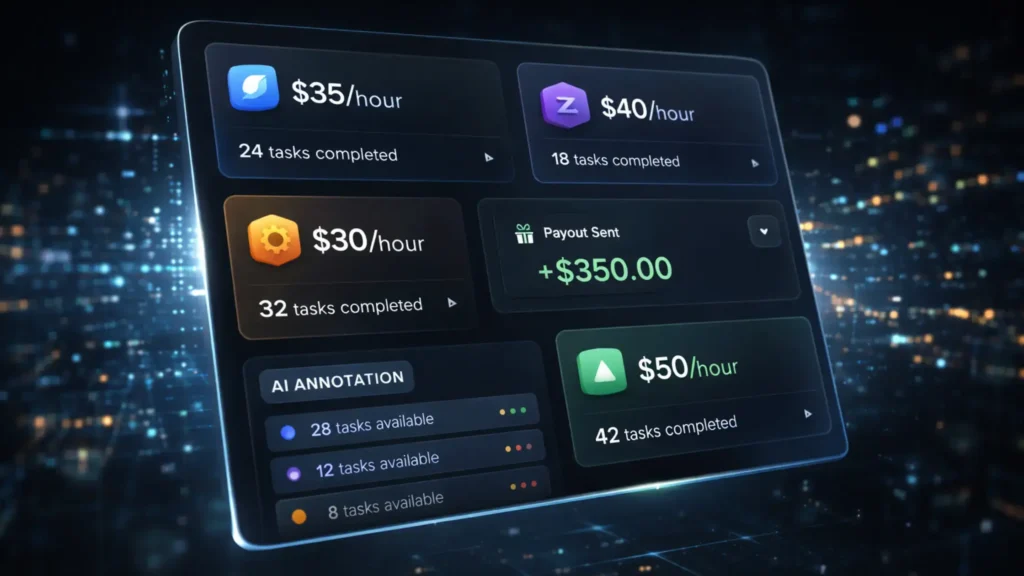
- Current Status: Very active in 2026, especially for long-form reasoning and “Vibe Coding” projects.
- Types of Tasks: Comparing AI-generated essays, fact-checking, and coding (Python/JS).
- Realistic Pay: $20–$25/hr for core work; $40–$45+/hr for coding projects.
- Pros: * Insanely flexible; work whenever you want.
- No minimum hours.
- Payouts are available every 7 days via PayPal.
Cons: * The “Black Box” application: If you don’t pass the initial test, you never hear back.
Occasional “empty dashboard” periods if your quality score dips.
How to Get Accepted: Take the assessment when you are 100% focused. Use zero AI help (they have detectors that will instantly ban you). Treat the writing portions like a professional exam.
Personal Insight: “I know people who have been on DA for two years straight. The key is never rushing. They track how long you spend on a page, and if you’re too fast, they assume you’re cheating or using AI.”
Outlier.ai (by Scale AI)
Outlier has grown massively in the last year. It’s the “pro” version of freelance annotation, often seeking people with specific degrees or deep expertise.
- Current Status: Dominant in 2026 for “Expert” tier projects (Math, Science, Humanities).
- · Types of Tasks: Advanced reasoning, multi-turn conversations with AI, and RLHF.
- · Realistic Pay: $18–$50/hr depending on your “tier.”
Pros: * Huge volume of work.
- Strong focus on U.S. experts.
- Weekly payouts are reliable.
Cons: * Onboarding can be buggy.
Projects can end abruptly, leaving you in “EQ” (Empty Queue) for a week.
- How to Get Accepted: Be very specific about your education and work history. If you have a degree in a specialized field, you’ll likely get a higher-paying project immediately.
- Personal Insight: “Outlier is great but can be stressful. They use Slack for communication, and it can feel like a corporate job sometimes. But for $40/hr? Most people find it worth the hassle.”
Mindrift (Powered by Toloka)
A newer player that has taken the 2026 market by storm. Mindrift focuses on “Generative AI Tutoring,” which is basically a fancy way of saying you’re teaching the AI to be a better writer and thinker.
- Current Status: Rapidly expanding their U.S. presence with high-quality “AI Tutor” roles.
- Types of Tasks: Creating high-quality dialogues, editing AI drafts, and “Red Teaming.”
- Realistic Pay: $20–$30/hr for U.S. writers; up to $80/hr for “Agent Evaluation Engineers.”
Pros: * Very professional interface.
- Clear feedback on your work quality.
- Focuses on “long-term” freelance relationships.
Cons: * Rigorous application process (CV + multiple tests).
They are picky about “native-level” writing style.
How to Get Accepted: Ensure your CV highlights any “editing” or “analytical” experience. They value quality over quantity.
Personal Insight: “Mindrift feels like the ‘luxury’ version of these platforms. They actually treat you like a professional editor rather than just a ‘clicker’.”
Remotasks
Remotasks has been around forever, but in 2026, they have pivoted heavily toward high-end projects for U.S. workers under their “Gold” and “Platinum” tiers.
Current Status: Stable, but best for those who can do complex Computer Vision tasks.
Types of Tasks: LiDAR (3D mapping), video annotation, and complex text categorization.
Realistic Pay: $15–$25/hr for U.S.-based annotators.
Pros: * Extensive training materials.
Regular webinars for project updates.
Cons: * The platform can be laggy.
Lower pay for “standard” tasks compared to DA or Outlier.
- How to Get Accepted: Complete as many training “bootcamps” as possible. Your pay increases as you unlock more difficult task categories.
- Personal Insight: “If you’re good at spatial puzzles, go for the LiDAR tasks. They are harder to learn but have much less competition than the writing tasks.”
TELUS International AI Data Solutions
Formerly Lionbridge, TELUS is the “Old Guard” of the industry. They are a massive corporation, which means things move a bit slower, but they are incredibly stable.
- Current Status: Focused on “Data Partnerships” and long-term search evaluation.
- Types of Tasks: Search engine evaluation, map quality, and linguistic labelling.
- Realistic Pay: $14–$22/hr (standard roles); $30–$50/hr (PhD/Specialist roles).
Pros: * Very reliable company
W-2 employee options in some U.S. states (with benefits!).
Cons: * The hiring process can take weeks.
Rigid guidelines that are sometimes hundreds of pages long.
- How to Get Accepted: Read the guidelines twice. Their exams are notorious for being tricky, and they often allow only one attempt.
- Personal Insight: “TELUS is the one you want if you want a ‘steady’ 20 hours a week without the chaos of smaller platforms.”
OpenTrain AI (aggregator)
OpenTrain AI isn’t a traditional platform—it’s a marketplace that aggregates opportunities from 20+ AI training companies, including many on this list.
You create one profile, and jobs from Data Annotation, Outlier, Scale contributors, and others flow into your inbox.
Pay varies by underlying platform—typically $20–$50+ for the best listings.
Pros:
- One-stop shop for opportunities
- Saves massive application time
- Free for freelancers
- Often exclusive listings
Cons:
- You still qualify per project
- Competition for top gigs
Sign up, build a strong portfolio, and apply through their system. It’s a game-changer for serious freelancers managing multiple streams.
Appen
Appen had a rough couple of years, but in 2026, they’ve reinvented themselves with “Appen China” and specialized Global projects that are now much better managed.
- Current Status: Rebounding with a focus on Multimodal AI and “Human Feedback” loops.
- Types of Tasks: Audio recording, image tagging, and sentiment analysis.
- Realistic Pay: $12–$20/hr for general tasks.
Pros: * Huge variety of “micro-tasks” (tasks that take 30 seconds).
Global reach (great for bilingual U.S. residents).
Cons: * Lower average pay than DA or Mindrift.
The “China” projects can have odd hours for U.S. workers.
- How to Get Accepted: Sign up for their “China” platform even if you’re in the U.S.; many high-paying 2026 projects are hosted there.
- Personal Insight: “Appen is great for filling the gaps. When your main platform is quiet, there’s almost always something small to do on Appen.”
Scale AI (Direct/Contributor)
While Scale AI owns Outlier, they also have direct contributor roles for high-level engineers and subject matter experts.
- Current Status: High-stakes, high-reward.
- Types of Tasks: Advanced RLHF for “Frontier” models (like GPT-5/6 levels).
- Realistic Pay: $30–$60+/hr
Pros: * Working on the absolute cutting edge.
- High pay for top-tier talent.
Cons: * Very high barrier to entry.
Extremely high quality-control standards.
- How to Get Accepted: Usually requires a specialized background or passing an “Expert Level” coding/reasoning test.
- Personal Insight: “This is where the ‘Pros’ go. If you can handle the pressure, the pay is life-changing for freelance work.”
Clickworker
Clickworker is the king of “mobile” annotation. If you like working from your phone while on the train, this is your best bet.
- Current Status: Very active in 2026 for UHRS (Universal Human Relevance System) tasks.
- Types of Tasks: Search relevance, side-by-side website comparisons.
- Realistic Pay: $10–$18/hr.
Pros: * Extremely easy to get started.
Mobile app is very solid.
Cons: * Low pay compared to specialized platforms.
UHRS tasks can be monotonous.
- How to Get Accepted: Take the “UHRS Assessment” on their site. It’s the gateway to 90% of their work.
- Personal Insight: “Don’t make this your main gig. It’s perfect for making an extra $50 a week in your spare time.”
Amazon Mechanical Turk (mTurk)
The “Grandfather” of the gig economy. In 2026, it’s mostly used for academic research and very small “micro-tasks” that feed larger AI systems.
- Current Status: Legacy platform; still reliable but outdated.
- Types of Tasks: Surveys, data cleaning, and very simple image labelling.
- Realistic Pay: $6–$12/hr (unless you have “Master” qualifications).
Pros: * Massive volume of tasks.
Instant payouts to Amazon gift cards or bank accounts.
Cons: * Too many low-paying “slave wages” tasks.
The interface looks like it’s from 2005.
- How to Get Accepted: Hard to get into nowadays as they’ve capped new U.S. workers, but if you have an old account, dust it off.
- Personal Insight: “Only use mTurk if you’re using ‘scripts’ (like MTurk Suite) to filter for high-paying tasks. Otherwise, you’ll work for $3 an hour.”
Comparison Table: Best Platforms for Freelance AI Data Annotation Side-by-Side
| Platform | Avg. Hourly Pay (USD) | Task Types | Work Availability | Payment Frequency | Best For | Overall Rating |
| DataAnnotation.tech | $20 – $45 | Writing, Coding | High | Weekly | Writers & Coders | 4.8/5 |
| Outlier.ai | $18 – $50 | Reasoning, RLHF | Medium-High | Weekly | Subject Experts | 4.2/5 |
| Mindrift | $20 – $35 | AI Tutoring | Medium | Bi-Weekly | Analytical Writers | 4.5/5 |
| Remotasks | $15 – $25 | LiDAR, Vision | High | Weekly | Visual Thinkers | 3.8/5 |
| TELUS Int. | $14 – $22 | Search, Maps | High | Monthly | Stability Seekers | 4.0/5 |
| OpenTrain AI | $20 – $30 | Niche Projects | Low-Medium | Per Project | Specialized Skills | 3.9/5 |
| Appen | $12 – $20 | Audio, Micro | Very High | Monthly | Beginners | 3.5/5 |
| Scale AI | $30 – $60 | Frontier AI | Low | Weekly | Tech Experts | 4.3/5 |
| Clickworker | $10 – $18 | Search Relevance | Very High | Weekly | Mobile Users | 3.2/5 |
| mTurk | $6 – $12 | Surveys, Tasks | Very High | Instant | Quick Gigs | 2.5/5 |
How to Get Started as a Freelance AI Data Annotator in 2026
Starting your journey as an AI annotator isn’t just about clicking “Sign Up.” In 2026, these companies are flooded with applicants, so you need a strategy to stand out.
Step-by-Step Application Guide
- Prepare Your Environment: You need a quiet room, a stable internet connection, and preferably a dual-monitor setup (it makes fact-checking so much faster).
- Clean Up Your Resume: Even for “no degree” roles, having a resume that mentions “attention to detail,” “analytical writing,” or “data entry” helps.
- Choose 2 Start-Off Platforms: Don’t apply to all 10 at once. I recommend starting with DataAnnotation.tech and Mindrift. They represent the highest quality/pay balance.
- Take the Assessment Seriously: These aren’t “buzzfeed quizzes.” They are real tests. Give yourself at least 2 hours of uninterrupted time.
Tips to Pass Assessments and Qualify Faster
- Follow Instructions Literally: If a guide says “Explain in 2-3 sentences,” and you write one or four, you are automatically disqualified.
- Show Your Work: In RLHF tasks, don’t just say “Response A is better.” Say “Response A is better because it correctly identifies the Newton-Raphson method whereas Response B hallucinated a formula.”
- Grammar is King: Use tools like Grammarly, but don’t let them rewrite your voice. The AI companies want human writing, not “AI-fixed” writing.
Tools and Setup You Need
- A Solid Laptop: Chromebooks often struggle with complex annotation interfaces. Get something with at least 8GB of RAM.
- Browser Extensions: Have a good “Dark Mode” extension and a “Time Tracker” to ensure you’re actually hitting your hourly goals.
- PayPal Account: 90% of the industry still runs on PayPal. Ensure yours is verified.
How to Maximize Earnings and Avoid Burnout
- The “Niche” Strategy: Once you’re in, look for projects in specialized fields. If you know a bit of Spanish, or how to read a balance sheet, your pay can double.
- Take Breaks: Your brain will turn to mush after 3 hours of judging AI responses. Use the “50/10 rule”—50 minutes of work, 10 minutes of walking away from the screen.
- Diversify: Never rely on just one platform. If DataAnnotation goes quiet, you should have an Outlier or TELUS project ready to go.
Red Flags and How to Spot Scam Platforms
The “work from home” niche is a magnet for scammers. Here is how to stay safe:
- They Ask for Money: A legitimate platform will never ask you for a “startup fee,” “equipment fee,” or “training deposit.”
- Vague Payment Terms: If they say “we pay in crypto only” or have no clear payment schedule, run.
- No Online Presence: Check the “Whois” data of the website. If the domain was registered 3 days ago, it’s probably a scam.
- Communication via Telegram/WhatsApp: Most legitimate platforms use their own dashboard or professional Slack/Discord channels. If a “recruiter” reaches out on WhatsApp offering $100/hr for simple tasks, it’s a trap.

(Conclusion)
If I had to pick the single best platforms for freelance AI data annotation right now, it’s still DataAnnotation.tech for its balance of pay, reliability, and growth potential. Outlier.ai takes the crown for absolute highest rates if you have strong skills, and Mindrift wins for creative, enjoyable work. Beginners should start with Remotasks or OpenTrain AI to build experience fast.
My biggest advice? Don’t put all your eggs in one basket. Sign up for DataAnnotation.tech, Outlier.ai, Mindrift, and OpenTrain AI today—you’ll thank yourself when projects overlap and your weekly deposits stack up. The AI data boom isn’t slowing down; demand for human judgment is only growing. This is one of the few remote fields where ordinary Americans with good English and work ethic can earn serious money while contributing to technology that’s changing the world. Get started now—you’ve got this.
Frequently Asked Questions
What is the best platforms for freelance AI data annotation for beginners?
Remotasks or Clickworker—low barriers and immediate work. Once you have experience, move to DataAnnotation.tech.
How much can I realistically earn?
Consistent U.S. freelancers on top platforms average $3,000–$7,000 monthly working 30–40 hours, with top performers exceeding $10,000.
Are these platforms open to non-U.S. residents?
Most are global, but U.S. workers often access higher-paying English-native projects and priority queues.
Do I need special skills or equipment?
Strong English and attention to detail are essential. No degree needed. A decent computer and internet suffice.
Is work availability consistent year-round?
It fluctuates, but 2026 demand remains high. Diversifying across platforms smooths gaps.
Can I do this full-time?
Yes—many do Combine 2–3 platforms for stability.
Are there opportunities for specialized fields like coding or biology?
Absolutely—DataAnnotation.tech, Outlier.ai, and Mindrift pay premium for domain expertise.
How quickly do payments arrive?
Top platforms pay weekly; others monthly. Always verify payout method before heavy commitment.