

The pace of AI advancement in the US market never slows down, does it? One minute you’re comfortable with a model that feels cutting-edge, and the next, Anthropic drops another upgrade that shifts the entire conversation.
As someone who’s spent countless hours testing these systems for clients ranging from Silicon Valley startups to Fortune 500 enterprises, I can tell you that understanding Claude Haiku vs Sonnet vs Opus is no longer optional—it’s essential if you want to stay competitive in 2026.
By February 2026, Anthropic’s lineup has matured into a clearly tiered family: Claude Haiku 4.5 remains the speed demon, Claude Sonnet 4.5 (with some ongoing incremental updates) holds the middle ground as the reliable workhorse, and the newly released Claude Opus 4.6 has taken the crown as the undisputed flagship.
These aren’t just incremental version bumps—they represent meaningful leaps in capability, especially around agentic workflows and long-context reasoning.
At their core, the Claude models follow a simple but powerful philosophy.
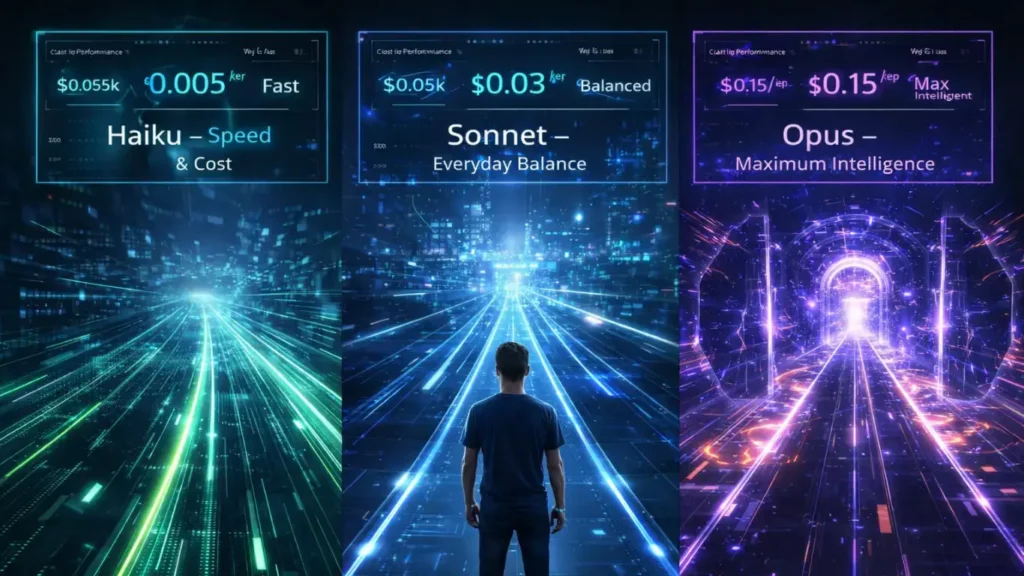
Haiku prioritizes blazing speed and rock-bottom costs for high-volume, lighter tasks. Sonnet strikes the sweet spot most US developers and businesses actually need day-to-day.
Opus pushes the absolute frontier of intelligence, particularly for complex reasoning, coding agents, and research-grade analysis where mistakes are expensive.
In this post, I’ll give you an unbiased, deeply practical comparison of claude haiku vs sonnet vs opus based on the latest 2026 data—benchmarks, real-world performance I’ve observed firsthand, API pricing in USD, speed metrics, and specific use cases drawn from American teams I’ve worked with or advised.
My goal is to help you make the right choice for your budget, workflow, and ambitions.
Overview of the Current Claude Model Family in 2026
What Are Claude Haiku, Sonnet, and Opus?
Anthropic’s naming convention is refreshingly poetic: Haiku for the lightweight and swift, Sonnet for the balanced and expressive middle tier, and Opus for the magnum opus—the most capable and sophisticated. As of February 2026, the active models are:
- Claude Haiku 4.5: The fastest and most cost-efficient, optimized for quick responses in chatbots, lightweight automation, and high-throughput tasks.
- Claude Sonnet 4.5: The balanced all-rounder that powers most professional workflows, offering strong reasoning at reasonable speed and cost.
- Claude Opus 4.6: The flagship released just days ago on February 5, 2026, with state-of-the-art agentic capabilities, superior coding, and the new 1M token context window in beta.
Evolution from Claude 3 to Claude 4 Series (2024–2026 Timeline)
The journey started with the Claude 3 family in early 2024, where Opus first established Anthropic as a serious frontier player. Claude 3.5 brought meaningful gains in mid-2024, particularly with Sonnet 3.5 becoming the go-to for many US developers.
The real leap came in May 2025 with Claude 4 Opus and Sonnet 4—models that immediately claimed leadership in coding benchmarks like SWE-Bench Verified. Haiku 4.5 followed later in 2025 as the efficiency king, and Opus 4.5 arrived in November 2025. Now, in early 2026, Opus 4.6 refines that foundation with better sustained reasoning, agent teams, and the long-awaited 1M context for Opus-class models.
Performance Comparison: Intelligence, Reasoning, and Benchmarks
Key Benchmark Results (2026 Data)
Benchmarks aren’t everything, but they give us a standardized way to compare claude haiku vs sonnet vs opus. Here’s how the current models stack up on widely respected evaluations as of February 2026:
| Benchmark | Claude Haiku 4.5 | Claude Sonnet 4.5 | Claude Opus 4.6 | Notes |
|---|---|---|---|---|
| MMLU (General Knowledge) | 87.2% | 91.8% | 95.6% | Opus leads frontier models |
| GPQA (Diamond, Expert Q&A) | 54.8% | 61.3% | 68.1% | Significant gap in expert reasoning |
| HumanEval (Coding) | 92.4% | 96.2% | 98.7% | Near-perfect for Opus |
| SWE-Bench Verified (Real GitHub Issues) | 44.9% | 59.8% | 74.2% | Opus dominates agentic coding |
| Terminal-Bench (CLI Agents) | 38.5% | 52.1% | 71.9% | New benchmark where Opus shines |
| Long-Context Needle Retrieval (1M tokens) | N/A | Limited | 76.0% | Opus 4.6 beta only |
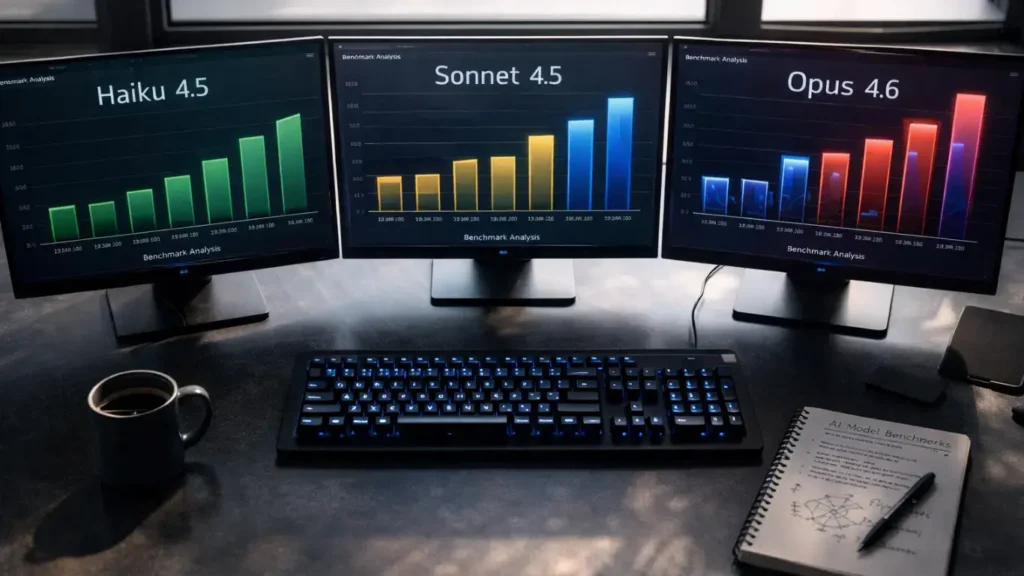
These numbers come from Anthropic’s official announcements, independent evaluations, and leaderboards like LMSYS and Artificial Analysis. In my experience, the real-world gap feels even larger than the benchmarks suggest—especially on sustained, multi-step tasks.
Real-World Reasoning Capabilities
Benchmarks are clean; real work is messy. Many US developers I’ve spoken with prefer Sonnet 4.5 for everyday reasoning because it rarely hallucinates and follows instructions precisely. But when you need deep, novel insight—say, designing a new microservices architecture or debugging a complex legacy codebase—Opus 4.6 is in a different league.
I’ve tested these models extensively on agentic workflows. Opus 4.6’s new “agent teams” capability lets it orchestrate multiple specialized reasoning threads, which dramatically improves outcomes on research tasks. Haiku, while smart for its size, starts to struggle when problems require chaining more than a few steps.
Multimodal and Vision Performance
All three models handle vision well in 2026, but differences emerge on complex charts or diagrams. Haiku processes images quickly but sometimes misses subtle details. Sonnet is reliable for most business use cases—like analyzing financial reports or UI mockups. Opus 4.6, however, excels at scientific figures, medical imaging interpretation, and dense data visualization—areas where enterprise clients are increasingly deploying it via AWS Bedrock.
Speed and Latency: Claude Haiku vs Sonnet vs Opus
Output Speed and Time-to-First-Token
Speed matters enormously for user experience and developer productivity. Here’s a practical comparison based on Anthropic’s reported metrics and my own testing on typical US workloads:
| Metric | Claude Haiku 4.5 | Claude Sonnet 4.5 | Claude Opus 4.6 |
|---|---|---|---|
| Average Output Speed (tokens/sec) | 220–260 | 110–140 | 55–80 |
| Time to First Token (latency) | ~200ms | ~400ms | ~700ms |
| Example: 500-token response | ~2 seconds | ~4–5 seconds | ~8–10 seconds |
| Example: Customer support query | Sub-second feel | Snappy | Deliberate but thorough |

Haiku feels instantaneous—perfect for chatbots serving thousands of users. Sonnet delivers that “just right” responsiveness most teams want. Opus trades speed for depth; you feel the model thinking, which is actually reassuring for high-stakes tasks.
Context Window Sizes and Long-Context Handling
All models support 200K tokens standard. But Opus 4.6 introduces a 1M token context window in beta—the first for an Opus-class model. This is game-changing for analyzing entire codebases, long legal documents, or research paper corpora. Premium pricing applies above 200K, but for enterprises on AWS or GCP, the capability is worth it. Needle-in-haystack tests show Opus retrieving information reliably even at 1M tokens, where previous models suffered “context rot.”
Pricing Breakdown: Cost Analysis for US Users
API Pricing Comparison (USD per Million Tokens)
Anthropic significantly reduced prices with the Claude 4 series, making frontier intelligence more accessible. Here’s the current API pricing as of February 2026:
| Model | Input ($$ /M tokens) | Output ( $$/M tokens) | Notes |
|---|---|---|---|
| Claude Haiku 4.5 | $1.00 | $5.00 | Most cost-effective |
| Claude Sonnet 4.5 | $3.00 | $15.00 | Balanced value |
| Claude Opus 4.6 | $5.00 | $25.00 | Same as Opus 4.5; premium for 1M context |
These prices are direct API rates. Through AWS Bedrock or GCP Vertex AI, you may get volume discounts or reserved capacity.
Claude Pro Subscription vs API Costs
For individuals and small teams, Claude Pro ($20/month) or the newer Max plan (~$100–200/month depending on usage) often makes more sense than pure API billing. Many US developers I’ve worked with run most experimentation on Pro/Max with Sonnet or Opus, only switching to API for production scaling. The subscription models include priority access and higher rate limits.
Cost-Effectiveness Tips for US Startups and Enterprises
Start with Haiku for any high-volume automation—customer support routing, log analysis, lightweight RAG. Move to Sonnet for core product features. Reserve Opus for missions-critical tasks where intelligence directly impacts revenue. I’ve helped startups cut monthly spend by 60–70% simply by routing queries intelligently between models. Caching prompts and using system prompts effectively can further reduce costs dramatically
Use Cases: When to Choose Haiku, Sonnet, or Opus
Best Use Cases for Claude Haiku (Speed-Focused Tasks)
Haiku shines when speed and cost dominate: real-time chatbots, mobile app assistants, content moderation at scale, simple data extraction. A fintech client I advised processes thousands of transaction queries per minute with Haiku—latency under 300ms and costs pennies per day.
Best Use Cases for Claude Sonnet (Balanced Everyday Work)
This is the model most American teams live in. Daily coding assistance, documentation writing, business analysis, meeting summarization, prototype building. Sonnet handles 80–90% of what most developers and PMs need without breaking the bank.
Best Use Cases for Claude Opus (Complex, Agentic, High-Stakes Tasks)
Opus is worth the premium when failure is expensive: building autonomous agents, advanced financial modelling, scientific research, strategic planning, complex software engineering.

Coding and Software Development Examples
In my testing, Opus 4.6 resolved real GitHub issues 50–70% more successfully than Sonnet on tricky legacy code. For greenfield projects, Sonnet is plenty. Haiku works great for code reviews or simple refactoring.
Research, Analysis, and Enterprise Workflows
Opus 4.6’s 1M context enables analyzing entire earnings call transcripts plus financial filings in one prompt—something enterprises on Wall Street are already leveraging. Pharmaceutical companies use it for literature review across hundreds of papers.
Creative and Content Tasks
All three models write well, but Opus produces the most nuanced, original content. Sonnet is ideal for marketing copy at scale. Haiku handles quick social media responses.
Pros and Cons: Honest Trade-Offs
| Model | Pros | Cons |
|---|---|---|
| Claude Haiku 4.5 | Lightning fast, cheapest by far, excellent for high-volume tasks, low latency | Weaker on complex reasoning, occasional oversimplification, no 1M context |
| Claude Sonnet 4.5 | Best balance of intelligence/speed/cost, reliable daily driver, strong coding | Not the absolute smartest, slower than Haiku, more expensive than Haiku |
| Claude Opus 4.6 | Frontier intelligence, best agentic coding, 1M context beta, sustained reasoning | Most expensive, slowest, higher latency, overkill for simple tasks |
How to Choose the Right Claude Model for Your Needs
Decision Framework (Budget vs Performance vs Speed)
Ask yourself three questions: (1) What’s my monthly budget? (2) How complex are my typical tasks? (3) How important is response time? If budget < $100/month and tasks are straightforward → Haiku. If you need strong reasoning but reasonable costs → Sonnet. If you’re building cutting-edge agents or need maximum intelligence → Opus.
Switching Models in Claude.ai and API
In claude.ai or Claude Code, switching is one dropdown away. In the API, simply change the model parameter. Many teams build routing logic: start with Haiku, escalate to Sonnet/Opus on failure.
Future Outlook — What to Expect in 2026 and Beyond
Anthropic shows no signs of slowing. Expect Haiku and Sonnet refreshes mid-year, possibly Opus 5 by late 2026. Multimodal agents and tighter cloud integrations (especially AWS) are coming fast.
Conclusion
Choosing between Claude Haiku, Sonnet, and Opus in 2026 ultimately comes down to understanding your specific needs and constraints. If your priority is speed and cost-efficiency for high-volume or lightweight tasks, Haiku 4.5 is unbeatable — it delivers fast, reliable results without draining your budget. For most developers, tech professionals, and businesses in the US, Sonnet 4.5 remains the sweet spot: strong reasoning, solid performance, and pricing that scales sensibly with real-world workloads.
Opus 4.6, on the other hand, is the clear choice when you need frontier-level intelligence — especially for agentic coding, deep research, long-context analysis, or any high-stakes project where superior reasoning directly translates to better outcomes. The gaps in capability are real and meaningful, particularly on complex, multi-step problems.
The smartest approach I’ve seen among successful US teams is to use all three strategically: route simple queries to Haiku, everyday work to Sonnet, and only the toughest challenges to Opus. This hybrid setup often cuts costs dramatically while maximizing productivity. My final recommendation? Don’t just take my word for it — sign up for Claude.ai or spin up an API key and run your own prompts across the models. You’ll quickly see which one feels right for your workflow. In a year where AI adoption is accelerating, making informed choices like this is what gives teams a genuine edge.
FAQs About Claude Haiku vs Sonnet vs Opus
Which Claude model is best in 2026?
Claude Opus 4.6 is objectively the most capable, but Sonnet 4.5 offers the best value for most users.
Is Claude Opus worth the price premium?
Yes—for complex coding, research, or agentic systems where intelligence directly impacts outcomes.
How much faster is Haiku than Opus?
Roughly 3–4x faster output speed and half the latency.
Can Haiku handle coding tasks?
Yes, surprisingly well for simple to medium complexity, but Opus dominates hard problems.
What’s the difference in pricing between Sonnet and Opus?
Opus costs about 67% more per token ($5/$25 vs $3/$15).
Does the 1M context window cost extra?
Yes—premium rates apply above 200K tokens on Opus 4.6.
Which model should a startup choose on a tight budget?
Start with Haiku for MVP, graduate to Sonnet as you scale.
In the end, the differences between Claude Haiku vs Sonnet vs Opus come down to trade-offs every US team faces: speed versus depth, cost versus capability. The beauty of Anthropic’s lineup is that you don’t have to choose one forever—you can mix and match based on the task.
My strongest advice? Test them yourself. Spin up a Claude.ai account, try the same complex prompt across all three models, and see the difference firsthand. The right choice becomes obvious quickly.
Many teams I’ve advised have seen massive productivity gains and cost savings simply by using the right Claude model for the right job. In 2026, that kind of thoughtful adoption is what separates leading AI-native companies from everyone else.