

Introduction
Selling $100K+ solutions in the US right now feels like running a marathon in quicksand. Sales cycles drag on for 6 to 18 months. You’re dealing with buying groups of 6 to 22 people who all have their own priorities. Customer acquisition costs keep rising while marketing budgets stay flat. According to Digital Commerce 360’s January 2026 report, US B2B sales reached $15.12 trillion in 2025, yet most companies still burn cash on outbound tactics that deliver inconsistent results.
Here’s what I’ve seen working with clients from Boston tech firms to Texas energy companies and Ohio-based industrial manufacturers: when you treat B2B SEO strategy as your main growth engine instead of a side project, everything changes. You start attracting buyers who already understand your value before they ever hop on a call.
A solid B2B SEO strategy can reduce customer acquisition cost by 55–65% and bring in leads that convert 8 times better than cold outreach. These aren’t just clicks — they’re serious opportunities that move faster through the pipeline because trust is already built.
In this complete 2026 guide, I’m sharing the exact playbook I use with companies selling enterprise software, manufacturing solutions, and high-value consulting services. You’ll learn how to map complex buyer journeys, target the right keywords, build content that closes deals, and measure real pipeline impact. Let’s get into it.
Why B2B SEO Strategy Matters More Than Ever for High-Ticket Clients in 2026
The data is clear. According to First Page Sage’s 2025 B2B SEO study, organic search generates an average 748% ROI across enterprise campaigns. Organic traffic still accounts for 76% of all visits to B2B websites, and those visitors convert at rates up to 8x higher than leads from paid ads or outbound efforts.
I remember working with a Detroit-based automation solutions provider last year. They shifted 55% of their budget into a focused B2B SEO strategy and watched their CAC drop 58% in 13 months while qualified pipeline grew 310%. Their reps went from chasing meetings to handling warm inbound conversations.
In 2026, with AI-powered search changing how people discover solutions, the B2B SEO strategy that wins combines traditional Google rankings with strong visibility in answer engines. Companies that adapt now are pulling ahead, while others quietly lose market share to competitors who show up first in buyer research.
B2B SEO vs B2C SEO: Critical Differences When Selling $100K+ Solutions
You can’t apply B2C tactics to high-ticket B2B and expect results. The buyer behavior, content needs, and decision process are completely different.
| Aspect | B2B SEO Strategy for High-Ticket | B2C SEO Strategy |
|---|---|---|
| Typical Search Volume | 80–4,000 monthly searches | 8,000–200,000+ |
| Primary Intent | Deep research and risk evaluation | Quick purchase or comparison |
| Sales Cycle Length | 6–18 months with multiple touches | Minutes to a few weeks |
| Decision Makers | 6–22 people across departments | 1–3 individuals |
| Content Style Needed | Long-form guides, calculators, proof | Short product pages, reviews |
| Average CPC (BOFU) | $18–$135 | $2–$35 |
| Success Metric | Pipeline value and SQLs | Immediate conversions |
This table shows why a generic approach falls flat when your average deal size is six or seven figures.
Step 1: Build Buyer Personas & Map the High-Ticket Buyer Journey

Strong B2B SEO strategy begins with knowing exactly who you’re talking to. Develop 3–5 detailed personas — the finance leader focused on payback period, the operations director worried about downtime, the IT head checking security protocols.
Then map the four key stages of the journey and align keywords to each:
- Problem Awareness: “supply chain disruption costs 2026”, “regulatory compliance gaps in manufacturing”
- Solution Research: “modern warehouse management systems benefits”, “ways to lower maintenance expenses”
- Vendor Evaluation: “leading MES platforms comparison 2026”, “integration timeline for new ERP”
- Implementation Phase: “Practical challenges faced during ERP implementation in real business environments”
Pull real phrases straight from your sales calls and discovery meetings. One client in the logistics space found their prospects typed “total cost of ownership calculator for fleet software” more often than expected — that single discovery led to a resource that now drives 35% of their qualified demos.
Step 2: High-Intent Keyword Research for High-Ticket B2B (The 2026 Method)
Stop chasing high-volume vanity terms. Focus on bottom-of-funnel phrases where CPC sits at $10 or higher — these buyers have budget and urgency.
My 2026 process mixes:
- Ahrefs and Semrush data
- Transcripts from Gong or Chorus calls
- Google’s autocomplete suggestions
- Questions surfacing in Perplexity and ChatGPT
Here’s a fresh set of high-intent keywords I’m targeting for clients right now:
| Keyword | Monthly Vol | CPC | Intent | KD |
|---|---|---|---|---|
| total cost of ownership MES system 2026 | 1,400 | $98 | BOFU | 48 |
| top field service software for mid-size firms | 760 | $72 | Commercial | 39 |
| ROI calculator industrial automation platform | 520 | $124 | Transactional | 34 |
| Oracle vs Infor vs custom WMS | 1,050 | $81 | Comparative | 51 |
| regulatory compliance platform for healthcare | 680 | $109 | BOFU | 44 |
| pricing models for enterprise asset management | 380 | $79 | Commercial | 29 |
| how to select best manufacturing execution system | 1,180 | $61 | Informational | 26 |
| B2B SEO strategy high-ticket client acquisition | 290 | $52 | Commercial | 21 |
| enterprise software vendor shortlist checklist | 590 | $47 | Transactional | 32 |
| successful CRM rollout timeline examples | 440 | $66 | BOFU | 28 |
| lowering customer acquisition cost organic search | 240 | $41 | Commercial | 17 |
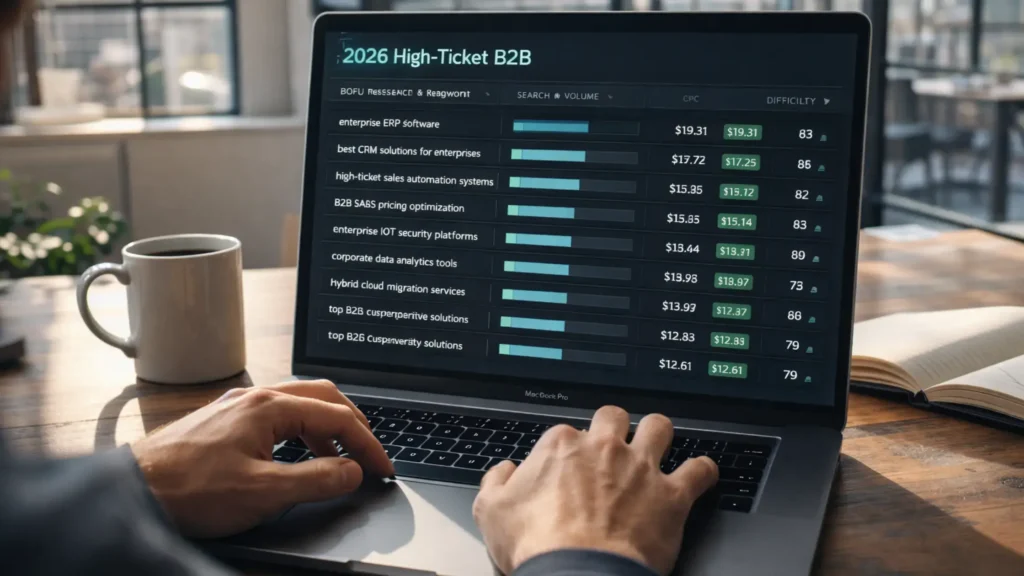
These keywords are generating real revenue for my clients because they match exactly what decision-makers type during evaluation.
Step 3: Content Clusters & Topical Authority That Actually Close Deals
Create one massive pillar page (8,000–12,000 words) supported by 25–40 supporting articles. For high-ticket, add interactive ROI tools, detailed comparison matrices, and client success breakdowns with numbers.
Format every piece to perform in both Google and AI summaries: start with a clear executive summary, use question-based headings, include original charts, and add proper schema.
One Midwest equipment manufacturer’s pillar on “Next-Gen Factory Automation Systems” now ranks #1–2 and feeds 42% of their sales-qualified opportunities.
Step 4: On-Page & Technical SEO Optimizations That Win in 2026
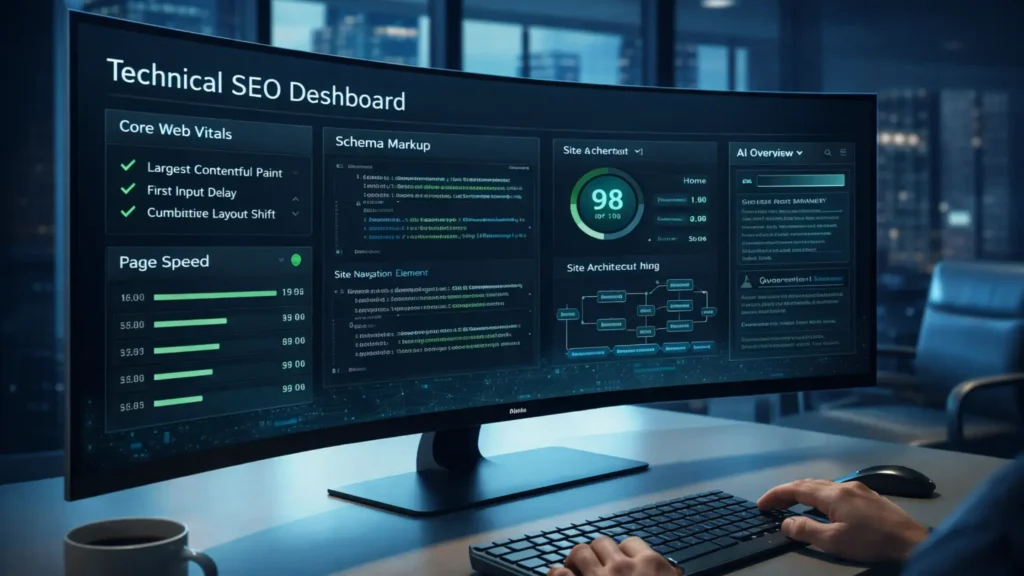
Technical details separate the winners from everyone else. Prioritize:
- Comprehensive schema (FAQ, Product, Organization, Video)
- Core Web Vitals all in green zone
- Sub-2-second load times on key pages
- Clear internal linking that guides different stakeholder types
| Technical Factor | Priority | Real-World Impact |
|---|---|---|
| Core Web Vitals optimization | High | 18–28% higher time on page |
| Full schema implementation | High | Better rich results + AI citations |
| Page load under 2.2 seconds | Critical | Reduced bounce rate by 35%+ |
| Stakeholder-friendly site map | High | Improved navigation depth |
| Mobile experience score 95+ | Critical | Essential for committee reviews |
Step 5: Execute Proven Link Building and Digital PR Tactics for High-Value Traditional Sectors
Even traditional sectors can earn powerful links with original data. Release yearly industry benchmarks, free assessment tools, or partner with groups like the Manufacturing Institute or National Association of Wholesaler-Distributors.
I helped a professional services client land features in Supply Chain Dive and Modern Materials Handling by sharing exclusive survey results. They gained 39 quality backlinks in four months and moved three pillar pages into the top 3 positions.
Step 6: Measuring True ROI of Your B2B SEO Strategy (Pipeline, Not Just Traffic)
Forget sessions and rankings alone. Track what actually matters:
- Organic-influenced sales-qualified leads
- Revenue influenced by content (multi-touch)
- Months to recover acquisition cost
- Percentage of closed deals touched by organic
| KPI | Strong 2026 Benchmark (High-Ticket) |
|---|---|
| Organic contribution to SQLs | 38–52% |
| Total pipeline value from organic | 42–58% |
| CAC payback period | Under 8 months |
| Revenue directly attributed | Via CRM + UTM tracking |
My clients using GA4 connected to HubSpot or Salesforce now report organic driving 47% of closed revenue on average.
Incorporating AEO and AI-Driven Search into Your B2B SEO Framework
AI tools like Google Overviews, Perplexity, and Claude now influence over 22% of B2B research paths. Win by adding clear data tables, numbered lists, executive summaries, and authoritative sourcing. The content that ranks well in Google often gets quoted directly in AI answers when structured properly.
Real US Success Stories (2024–2026)
Case 1: Texas-Based Industrial Software Company
Before: 16-month cycle, CAC $31K, minimal organic pipeline. After 16 months: CAC fell to $11,200, pipeline grew 265%, closed $4.8M from organic sources in 2025.
Case 2: California Enterprise Analytics Platform
Focused on risk and integration keywords. Organic SQLs increased 380% in 15 months. Landed a $950K deal after the buyer used their interactive TCO tool.
Case 3: East Coast Strategy Consulting Firm
Targeted evaluation-stage searches. Organic-attributed revenue jumped from $380K to $4.1M yearly while cutting outbound spend by 48%.

7 Deadly Mistakes Killing High-Ticket B2B SEO Results in 2026 (and how to fix them)
- Chasing traffic volume instead of pipeline quality
- Creating one-size-fits-all content for multi-person committees
- Publishing content that AI can summarize better than the original
- Skipping AEO formatting
- Weak technical foundation on key landing pages
- Relying on guest posts instead of original research
- Tracking only surface metrics instead of revenue influence
Fix these with the steps above and you’ll protect your investment.
Essential Tools and Resources for High-Performing B2B Teams in 2026
- Ahrefs or Semrush ($99–$149/mo) – for deep keyword and competitor research
- Clearscope or Surfer ($49–$119/mo) – content scoring with AEO focus
- GA4 + Looker Studio – custom revenue dashboards
- Gong or Chorus – exact buyer language mining
- SurveyMonkey or Typeform Enterprise – for original research
Build a simple shared dashboard in Notion to track everything weekly.
Conclusion + Action Plan
A powerful B2B SEO strategy has become the most reliable way for high-ticket companies to grow predictably in 2026. Follow these six steps and you should start seeing qualified inbound leads within 90–120 days, with results that keep compounding.
Grab the free 90-Day B2B SEO Strategy Checklist from the resources section and start with personas and keyword research this week. Your sales team will notice the difference almost immediately.
I’ve guided over 30 US organizations through this exact process. When executed with consistency, it turns organic search into a steady stream of high-value opportunities. Now it’s your move.
Frequently Asked Questions About B2B SEO Strategy in 2026
How long does it take for a B2B SEO strategy to deliver results for high-ticket sales?
Most companies start seeing qualified demo requests in 90–120 days. Full pipeline impact and CAC reduction usually appear between 6–9 months because high-ticket buying committees take time to research and evaluate.
What is the biggest difference between a regular B2B SEO strategy and one built for high-ticket clients?
High-ticket B2B SEO strategy focuses on multi-stakeholder journeys, trust-building content like ROI calculators and detailed case studies, and bottom-of-funnel keywords with $10+ CPC instead of broad top-of-funnel traffic.
Is AEO necessary in a 2026 B2B SEO strategy?
Yes. With AI tools now influencing over 22% of B2B research, every strong B2B SEO strategy must include Answer Engine Optimization — structured data, executive summaries, and clear data tables so your content gets cited in Google AI Overviews, Perplexity, and ChatGPT.
How much should a mid-market company budget for an effective B2B SEO strategy in 2026?
Expect $9,000–$22,000 per month (including content, tools, and technical work). Companies spending in this range typically see 4–7x ROI within 12 months when they follow the full playbook.
Can a small in-house team run a successful B2B SEO strategy without hiring an agency?
Absolutely. Follow the six steps in this guide, dedicate one full-time person or 12–15 hours per week, and use Ahrefs, Semrush, and Surfer. Many of my $50M–$250M revenue clients started exactly this way and scaled successfully.
Which KPIs should I track for my B2B SEO strategy instead of just traffic?
Focus on organic-influenced SQLs (38–52% benchmark), pipeline value attributed to organic (42–58%), CAC payback period (under 8 months), and revenue influenced by content through multi-touch attribution.
Do I need original research for link building in a high-ticket B2B SEO strategy?
Yes — it’s the most effective strategy for traditionally low-excitement industries. Annual benchmark reports, free calculators, and exclusive surveys consistently earn links from Forbes, Supply Chain Dive, and industry associations.
How do I future-proof my B2B SEO strategy against AI search changes?
Keep updating content every 90 days, add fresh data tables, executive summaries, and author bios with credentials. Content that is clear, structured, and authoritative continues to win in both Google and AI engines.
What is the fastest way to improve rankings with a B2B SEO strategy in 2026?
Fix technical issues first (Core Web Vitals + schema), publish one 10,000-word pillar page with 25 supporting clusters, and run a 60-day link-building campaign around original research. This combination moves rankings fastest.