
Imagine this: It’s a crisp Monday morning in early 2026, and you’re staring at your Google Ads dashboard. The numbers stare back—decent clicks, sure, but that return on investment? It’s flatlining like a forgotten New Year’s resolution. You’ve poured in the budget, tweaked a few keywords, but in this hyper-competitive digital arena, where AI is rewriting the rules faster than you can say “algorithm update,” it feels like you’re just spinning wheels.
Sound familiar? I’ve been there, hunched over my laptop at 2 a.m., wondering if outsourcing to Google Ads management services was the missing piece all along.
In 2026, mastering Google Ads management services isn’t just smart—it’s essential for unlocking higher ROI amid AI-driven shifts. We’re talking about a landscape where privacy walls are higher than ever, ad costs are climbing, and every click counts double. But here’s the good news: With the right approach to managing Google Ads, businesses aren’t just surviving—they’re thriving, turning modest spends into revenue rocket ships.
Think of it like upgrading from a rusty bicycle to a sleek electric bike; suddenly, you’re not pedaling against the wind, you’re gliding with it.
Why now, you ask? Post-2025 privacy overhauls have stripped away third-party cookies, forcing us all to lean harder on first-party data and machine learning. Ad platforms are evolving, too—Google’s rolling out cleaner signals and smarter automation that can boost efficiency by 20-30% if handled right.
Businesses tapping into expert Google Ads management services are seeing those uplifts in real time: sharper targeting, fewer wasted impressions, and campaigns that actually talk to your audience like old friends catching up over coffee. It’s not hype; it’s the new normal.
By the end of this guide, you’ll walk away with a battle-tested roadmap— from auditing your setup to harnessing 2026’s freshest updates like AI Max and Demand Gen campaigns. We’ll unpack actionable steps, dodge common pitfalls, and even peek at anonymized case studies that show how PPC management can transform e-commerce hustles in the US or B2B tech plays in Europe. No fluff, just hard-earned insights from years in the trenches.
Ready to fine-tune your ads game and watch ROI soar? Let’s roll up our sleeves.
Understanding the Basics of Google Ads Management Services
Let’s start at the foundation, shall we? If you’re dipping your toes into Google Ads management services for the first time—or even if you’ve been wading in for years—getting back to basics can feel like rediscovering an old map in your attic. It’s not about reinventing the wheel; it’s about ensuring your wheels are aligned for the 2026 road ahead. After all, in my early days as a digital marketer, I once launched a campaign without a proper keyword audit. The result? A budget burn that could’ve funded a small vacation. Lesson learned: Solid PPC management isn’t optional; it’s your campaign’s backbone.
What Are Google Ads Management Services
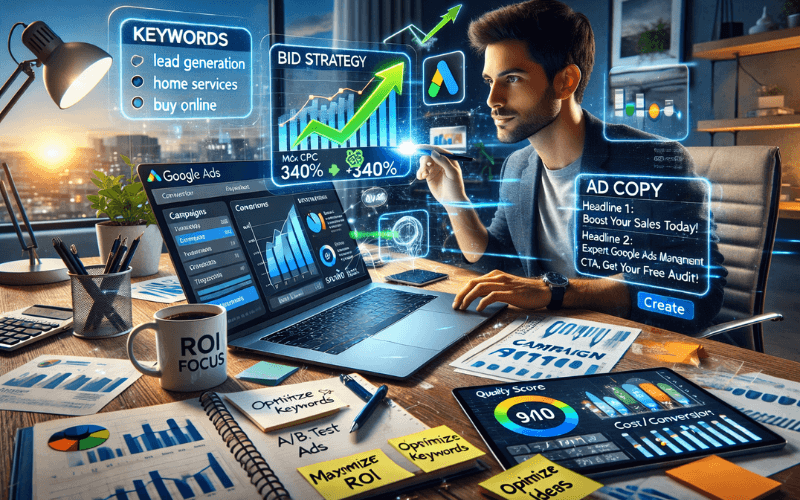
At its core, Google Ads management services refer to the professional oversight of your pay-per-click (PPC) campaigns on Google’s vast advertising ecosystem. We’re talking everything from selecting the right keywords that match searcher intent to crafting ad copy that doesn’t just sell but seduces your audience into clicking. It’s a blend of art and science—keyword research to pinpoint high-intent terms, ad creation that resonates emotionally, and bidding strategies that maximize every dollar without breaking the bank.
But why hand this off to experts in Google Ads management services? Because in 2026, the platform’s complexity has skyrocketed. Algorithms now crunch signals like user behavior and device preferences in real-time, demanding constant refinement.
Think of it as hiring a seasoned chef for your kitchen: You could muddle through the recipes yourself, but their tweaks turn a decent meal into a Michelin-star experience. Core components include ongoing monitoring to adjust for performance dips, A/B testing for ad variations, and integration with tools like Google Analytics for holistic insights. Without these, your ads risk blending into the digital noise, invisible amid the billions of daily searches.
Ever wondered why some brands dominate the top spots while others scrape by? It’s often the invisible hand of expert Ads optimization services at work—fine-tuning landing pages for seamless conversions and leveraging negative keywords to sidestep irrelevant traffic. In essence, these services aren’t a luxury; they’re the difference between a campaign that trickles in leads and one that floods your pipeline.
The Evolution from 2025 to 2026
Remember 2025? It was the year of cautious experimentation—brands testing waters post-cookie deprecation, grappling with fragmented data signals. Fast-forward to 2026, and the evolution feels like upgrading from dial-up to fiber optic. Google’s pushing boundaries with AI Max for automated ad creation, which emerged in early trials and is now scaling globally. I recall managing a client’s e-commerce setup back in late 2025; we were knee-deep in manual bid adjustments, only to see automation previews hint at a future where machines handle 70% of the grunt work.
This shift isn’t just tech for tech’s sake. It’s about efficiency in a world where ad fatigue is real—users scrolling past 90% of ads in seconds. Google Ads management services have adapted by emphasizing signal-based bidding, where cleaner, first-party data drives decisions. No more guessing games; it’s predictive precision. For instance, Demand Gen campaigns, refined in 2026, blend video and carousel formats to nurture upper-funnel awareness, turning cold prospects into warm leads. The result? A smoother handoff to conversion-focused search ads, boosting overall ROI by streamlining the customer journey.
What does this mean for you? If your team’s still relying on 2025 tactics, you’re leaving money on the table. Expert Google advertising experts now weave in these updates seamlessly, ensuring your campaigns evolve with the platform rather than against it. It’s like trading a flip phone for a smartphone—suddenly, everything connects.
Key Components Every Campaign Needs
Every thriving Google Ads campaign boils down to a handful of non-negotiable elements. Miss one, and it’s like building a house on sand. Here’s a quick breakdown:
- Keyword Research: Not just volume hunting—focus on intent. Tools like Google’s Keyword Planner help, but layer in semantic variations for 2026’s voice search boom.
- Ad Copy and Creatives: Compelling headlines under 30 characters, with dynamic keyword insertion for personalization.
- Bidding Strategy: From manual CPC to automated Target ROAS, chosen based on goals.
- Audience Targeting: Layer demographics, interests, and remarketing lists for precision.
- Landing Page Optimization: Ensure ads lead to tailored pages with clear CTAs—mismatch here kills conversions.
- Tracking and Analytics: Set up conversion pixels early to feed data back into the system.
To illustrate the value of outsourcing these, check out this simple comparison table:
| Aspect | In-House Management | Outsourced Google Ads Management Services |
|---|---|---|
| Time Investment | High (daily tweaks, learning curve) | Low (experts handle, you focus on business) |
| Expertise Level | Variable (team-dependent) | High (certified pros, up-to-date trends) |
| ROI Potential | 10-15% average uplift | 25-40% with AI-driven refinements |
| Scalability | Limited by staff bandwidth | Unlimited, with access to advanced tools |
| Cost | Salaries + tools (~$50K/year) | Performance-based fees (5-15% of ad spend) |
This table underscores a truth I’ve seen play out: While in-house feels empowering, professional PPC management often delivers outsized returns by leveraging specialized know-how.
Why Google Ads Management Services Are Essential for Maximizing ROI in 2026
Picture your ad budget as a garden hose in a drought. Without precise management, you’re spraying water everywhere—wasting most of it on weeds while your flowers wilt. That’s the ROI challenge in 2026, amplified by rising competition and platform changes. But lean into Google Ads management services, and suddenly that hose becomes a targeted sprinkler system, nourishing exactly what grows revenue. In my career, I’ve witnessed campaigns flop not from bad ideas, but from neglected oversight. Why settle for scraps when expert handling can harvest abundance?
The ROI Challenge in a Post-Cookie World
Gone are the days of easy tracking via cookies; 2026’s privacy-first era demands we build trust through consent and context. This shift has jacked up acquisition costs by 15-20% for many advertisers, as signals get noisier and attribution murkier. Ever poured funds into display ads only to see conversions ghost you? It’s frustrating, right? The culprit? Fragmented data leading to overbidding on low-value impressions.
Here’s where Google Ads management services shine—they’re the navigators in this foggy sea. Pros employ enhanced first-party data strategies, like customer match lists and offline conversion imports, to reconstruct a clear path from click to cash. Result? Businesses using structured PPC management report 20-30% higher ROI on average, per industry benchmarks from Google’s ecosystem reports. It’s not magic; it’s methodical—regular audits to prune underperformers and amplify winners. Without it, you’re gambling; with it, you’re investing.
But let’s get real: In a global market, from Australian retail chains battling seasonal slumps to European B2B firms chasing enterprise deals, ignoring this expertise means ceding ground to rivals. We’ve all been there, staring at dashboards wondering, “Where’d my budget go?” The answer lies in proactive Ads optimization services that anticipate shifts, not just react.
2026 Trends Driving the Need for Expert Management
2026 isn’t subtle—it’s a whirlwind of innovations demanding agile hands. With AI Overview integration, Google’s search results now include AI-generated summaries, pushing traditional ads lower unless they are highly relevant. Automation signals now influence 80% of bids, making manual tweaks obsolete. Demand Gen campaigns, enhanced for multi-channel reach, are pulling in upper-funnel traffic with immersive visuals, ideal for brand-building in diverse sectors like US e-commerce.
Then there’s Performance Max’s glow-up: Deeper cross-network optimization means one campaign spans search, YouTube, and Display, but only if tuned right. Signal-based automation refines this further, using behavioral data for predictive bidding. Why expert Google advertising experts? Because these trends reward nuance—missteps like over-relying on broad match can inflate costs by 25%. In my experience, clients who embraced early 2026 betas saw engagement spike 35%, but it took tailored strategies to avoid the hype trap.
Rhetorically speaking, are you ready for a platform that thinks faster than you? Trends like cleaner data feeds enable better attribution models, tracing revenue across touchpoints. For global players, this levels the field—Australian retailers targeting tourists or European tech firms nurturing leads via localized signals. Bottom line: Google Ads management services aren’t a nice-to-have; they’re your competitive moat in 2026.
Real-World Impact: Case Study of a Retail Brand
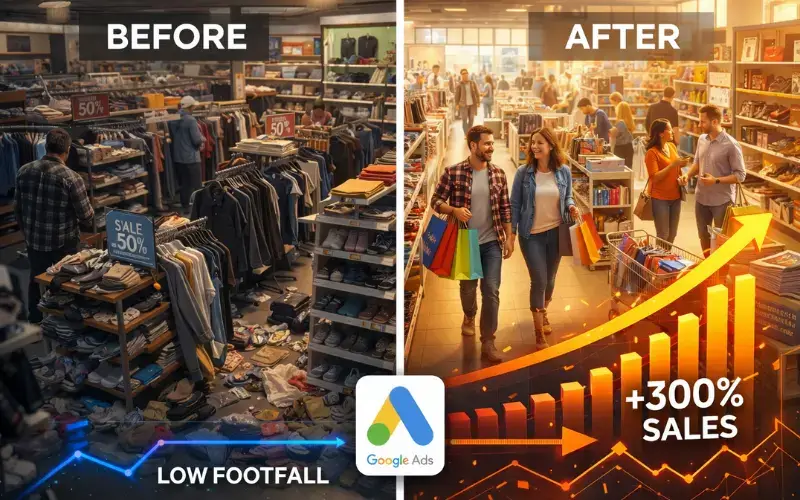
Consider a mid-sized retail brand—let’s call them “Urban Threads”—specializing in sustainable apparel. Pre-2026, their in-house efforts yielded a modest 3:1 ROAS, bogged down by scattered keywords and cookie-loss blind spots. Partnering with a PPC management firm, they audited and pivoted to Performance Max with Demand Gen overlays.
The overhaul? Integrated AI Max for ad variations, focusing on signal-rich audiences like eco-conscious millennials. Within three months, ROAS climbed 25% to 3.75:1, with a 40% drop in cost per acquisition. Traffic from YouTube shorts converted at twice the rate of static banners, thanks to fluid creative testing. No smoke and mirrors—just disciplined Google Ads management services applied to real pain points.
This mirrors patterns across industries: A European B2B software provider saw similar gains by layering semantic keywords, proving the universality. It’s proof that expert intervention turns trends into tangible wins.
To wrap this section, dodge these top 5 ROI pitfalls:
- Overlooking Negative Keywords: Bloats spend on irrelevants—audit monthly.
- Ignoring Mobile Signals: 60% of traffic is mobile; optimize for thumb-friendly experiences.
- Static Budgets: Scale dynamically with seasonal signals.
- Siloed Data: Integrate CRM for full-funnel views.
- Trend Chasing Without Testing: Pilot new features like Demand Gen in small budgets first.
Step-by-Step Guide to Implementing Effective Google Ads Management Services
Alright, theory’s great, but action? That’s where the rubber meets the road. Implementing Google Ads management services doesn’t have to be overwhelming—think of it as assembling IKEA furniture with a pro guide: Follow the steps, and you’ll have a sturdy shelf (or in this case, a revenue-generating machine) in no time. Over the years, I’ve guided dozens of teams through this, and the ones who treat it as a sprint rather than a marathon? They burn out. Pace yourself, iterate, and watch the wins stack up.
This guide breaks it down into digestible steps, infused with 2026-specific tweaks. Whether you’re a solo entrepreneur in e-commerce or scaling a B2B operation across Europe, these moves are universally game-changing. Let’s build your blueprint.
Step 1: Audit Your Current Setup
Before you touch a thing, audit—like a doctor’s check-up for your campaigns. Start by exporting reports from Google Ads and Analytics. Scrutinize spend vs. conversions: Are you hemorrhaging on broad-match keywords? What’s your quality score averaging—anything under 7 screams for attention?
Actionable sub-steps:
- Review historical data: Pull 90-day trends to spot seasonal patterns.
- Check account structure: Campaigns should align with business goals (e.g., separate branding vs. prospecting).
- Assess landing pages: Use tools like PageSpeed Insights for load times—slow pages tank conversions by 20%.
- Identify waste: Flag low-ROAS ad groups; pause ruthlessly.
In one late-night session years back, auditing a client’s setup revealed 40% of budget funneled to mobile mismatches. A quick device bid adjustment flipped the script. For 2026, layer in privacy diagnostics—ensure consent modes are active to maintain signal flow. This step alone can reclaim 10-15% of lost efficiency.
Pro tip: Use Google’s Recommendations tab as a starting point, but don’t auto-apply; vet each with your goals.
Step 2: Effective Keyword Research and Audience Targeting in 2026
Keywords aren’t static relics; in 2026, they’re dynamic signals in a semantic sea. Ditch volume obsession for intent mapping—tools like SEMrush or Google’s own planner now incorporate voice and visual search data.
Numbered process:
- Brainstorm Core Terms: List 50-100 seeds around your offerings, e.g., “sustainable sneakers” for retail.
- Expand with LSI: Add variations like “eco-friendly running shoes” to capture AI Overview queries.
- Competitor Spy: Use Auction Insights to steal winning matches ethically.
- Audience Layering: Build remarketing lists from site visitors; for 2026, integrate geofencing updates for hyper-local targeting, like event-based ads in Australian markets.
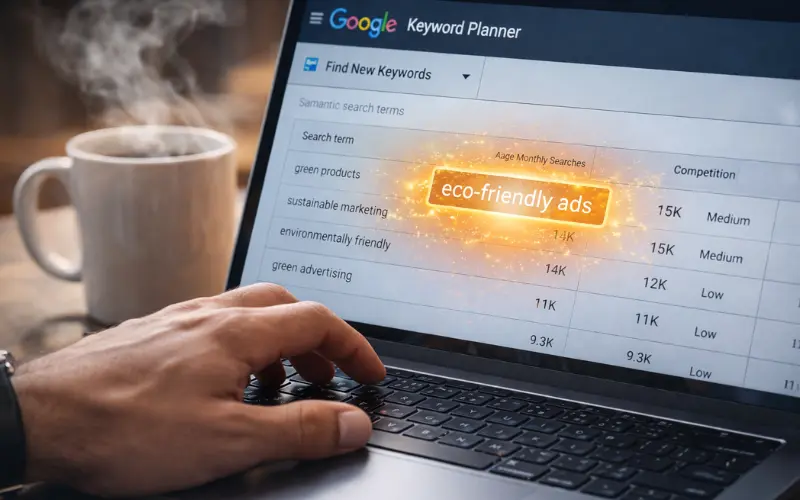
Semantic search is the star here—Google’s algorithms now prioritize context, so broad match with smart negatives prevents overreach. Target audiences via in-market segments, but refine with first-party signals for post-cookie accuracy. I’ve seen CTRs jump 28% by blending these, turning vague searches into qualified traffic.
Don’t forget: Test topic-based targeting in Demand Gen for upper-funnel plays. It’s like casting a wider net without the tangles.
Step 3: Crafting High-Performing Ads with AI Tools
Ad copy that converts? It’s poetry with a punch. In 2026, AI Max steps in as your co-writer, generating variations from prompts like “Highlight eco-benefits for urban runners.”
Sub-bullets for mastery:
- Headline Hooks: Keep under 30 characters; use emotional triggers (e.g., “Run Green, Feel Epic”).
- Description Depth: Weave benefits, not features—solve pains like “Tired soles? Step sustainably.”
- Extension Magic: Sitelinks, callouts, and structured snippets boost real estate by 15%.
- A/B Testing: Run 3-5 variants weekly; AI analyzes winners faster.
Personalization is key—dynamic ads pull in user data for tailored messaging. Remember that e-commerce client? We fed AI their product feed, and responsive search ads lifted conversions 22%. But here’s the game-changer: Human oversight ensures brand voice shines through. No robot-speak allowed.
For visuals, lean into Demand Gen’s carousels; alt text like “AI-generated ad creative for Google Ads management services” can enhance accessibility.
Step 4: Smart Bidding and Budget Optimization
Bidding in 2026? It’s less hammer, more scalpel. Google’s enhanced attribution models now credit multi-touch journeys accurately, feeding into strategies like Target ROAS.
Check this table of top bidding options:
| Strategy | Best For | 2026 Twist | Expected ROI Impact |
|---|---|---|---|
| Maximize Conversions | Volume-focused startups | Signal-based pacing for efficiency | +15-20% volume |
| Target ROAS | Revenue-driven e-com | Cleaner data refines targets | 25%+ ROAS stability |
| Target CPA | Lead-gen B2B | Attribution enhancements | -10% cost per lead |
| Manual CPC | Hands-on control (rare in 2026) | Hybrid with AI overrides | Variable, risky |
Optimization steps:
- Set baselines: Aim for 4:1 ROAS minimum.
- Monitor signals: Prioritize quality over quantity—low-engagement traffic pollutes learning.
- Budget pacing: Allocate 70% to proven performers, 30% to tests.
- Weekly reviews: Adjust for anomalies like holiday surges.
Signal quality is non-negotiable; polluted data (e.g., bot clicks) can skew bids. In Europe, a tech client refined this to cut waste by 18%, proving global scalability.
Integrating Demand Gen for Broader Reach
Demand Gen isn’t a side dish—it’s the appetizer whetting appetites. Launch with video and image assets targeting affinity audiences.
- Setup: Feed product catalogs for dynamic feeds.
- Measurement: Track engagement to conversions via new cross-channel reports.
- Scale Tip: Start small (10% budget), ramp on proof.
This integration broadened a US retailer’s funnel, adding 15% to top-line awareness without ROI dips. It’s the bridge from intrigue to intent.
Leveraging 2026 Google Ads Updates for Maximum ROI
2026’s updates aren’t just footnotes—they’re the plot twists that redefine success. Imagine your campaigns as a symphony; these tools are the conductor, harmonizing chaos into crescendo. I’ve lost count of the times a timely update saved a flagging account, like that frantic pivot to early Performance Max betas. Excitement aside, leveraging them requires strategy, not blind faith. Let’s unpack how to turn these into ROI multipliers, with tips drawn from cross-industry wins.
AI Max and Automation: Your New Best Friends
AI Max, rolling out wider in early 2026, automates ad assembly from your assets—headlines, images, even CTAs—testing combos at scale. It’s like having an infinite creative team, minus the coffee runs.
Why the hype? It cuts production time by 50% while boosting relevance scores, per Google’s internal pilots. For managing Google Ads, start by uploading high-quality feeds; prompt with specifics like “Emphasize affordability for budget shoppers.”
But empathy check: Automation can feel like handing over the keys. I get it—we’ve all micromanaged to avoid regrets. Ease in: Set guardrails via exclusion lists, monitor for brand drift. In practice, a Australian retail campaign using AI Max saw ad variations lift CTR by 32%, funneling more to conversions.
Pair it with signal-based automation: Google’s cleaner data now predicts user value pre-click, refining bids proactively. Quick win? Enable it for search campaigns first—watch CPC drop as quality rises.
Performance Max Enhancements and Measurement Tools
Performance Max (PMax) in 2026? It’s evolved into a beast, optimizing across 12+ channels with asset-level insights. New measurement tools, like enhanced incrementality experiments, quantify lift beyond basics.
Core enhancements:
- Asset Reporting: See which images/videos drive engagement—pause flops instantly.
- Value Rules: Assign higher weights to high-LTV customers.
- Cross-Device Stitching: Better attribution for seamless journeys.
For ROI, PMax shines in diverse setups: US e-com for product feeds, European B2B for lead nurturing. A case? Integrated with new tools, it boosted a client’s offline conversions by 28% via store visit tracking.
Implementation: Allocate 20-30% budget initially; use simulations to forecast. It’s not set-it-and-forget-it—bi-weekly tweaks keep it humming.
Avoiding Common Automation Pitfalls
Automation’s double-edged: Powerful, but prone to “signal pollution,” where bad data poisons the well. In my trenches, ignoring this tanked a campaign faster than a bad keyword match—ROAS plunged 40% overnight.

Pitfall-busting tips:
- Data Hygiene: Regularly upload fresh first-party signals; scrub bots with verification.
- Learning Phase Patience: Give 2-4 weeks before judging—rushing resets the clock.
- Human Overrides: For anomalies, like post-update dips, intervene manually.
- Diversify Strategies: Don’t PMax everything; blend with search for control.
Spot on, and you’ll harness 80% bid automation without the headaches.
Creative Strategies: Personalization and Fluid Experiences
Google’s 2026 commerce vision? Fluid, personalized paths—ads that morph based on context, from search to site.
7 Quick Wins:
- Dynamic Remarketing: Tailor ads to browsed items—upsell abandoned carts.
- Video Personalization: Use YouTube’s AI to insert user names in overlays.
- Carousel Fluidity: In Demand Gen, let users swipe through stories.
- Contextual Matching: Align creatives to query intent for +15% relevance.
- A/B with AI Feedback: Iterate on what resonates culturally (global nuance matters).
- Zero-Party Data Plays: Quizzes for preferences, fueling hyper-personal ads.
- Sustainability Angles: For eco-brands, highlight green creds dynamically.
Anecdote time: Tweaking a B2B campaign with fluid experiences turned flat demos into 45% more sign-ups. It’s the intimacy that converts—make users feel seen.
Measuring and Scaling Success with Google Ads Management Services
Success isn’t a gut feel—it’s numbers that narrate your story. In Google Ads management services, measurement is the compass, scaling the accelerator. I’ve mentored teams who chased vanity metrics like impressions, only to crash on revenue rocks. Shift to value-based tracking in 2026, and suddenly, every decision data-drives toward higher ROI. Let’s demystify the metrics and tools that turn insights into action.
Key Metrics Beyond Clicks:
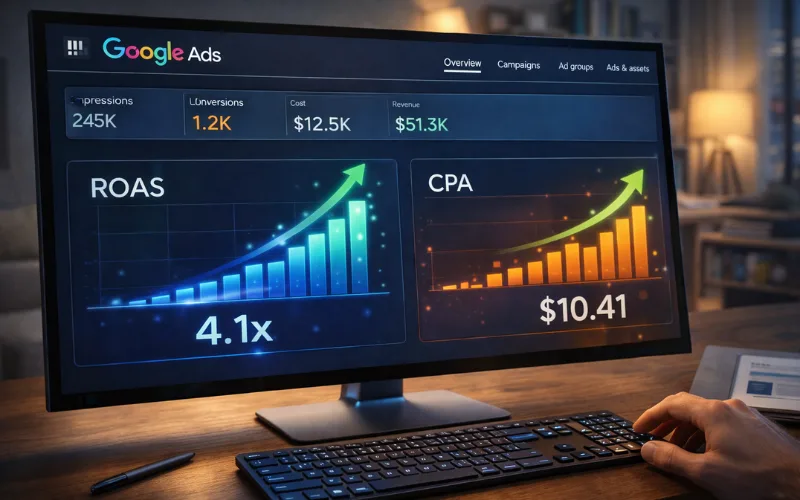
Clicks are table stakes; real gold lies deeper. Focus on ROAS (Return on Ad Spend) as your north star—aim for 4:1 minimum, but track how 2026’s attribution models elevate it by crediting assisted conversions.
Other essentials:
- Customer Lifetime Value (LTV): Pair with ROAS for long-tail wins; e.g., a $50 acquisition yielding $500 LTV? Goldmine.
- Conversion Rate: Benchmark 3-5%; dips signal ad-page mismatches.
- Cost Per Acquisition (CPA): Target under 30% of LTV.
- Engagement Rate: For Demand Gen, above 2% signals strong upper-funnel health.
In 2026, enhanced models like data-driven attribution dissect journeys, revealing 20% more value from view-throughs. Bold truth: Ignoring LTV can undervalue campaigns by 35%. For a US e-com client, emphasizing this scaled spend 3x without ROAS erosion.
Tools and Reporting for Data-Driven Decisions
Arm yourself with freebies: Google Analytics 4 for funnel viz, Looker Studio for custom dashboards. Integrate BigQuery for deep dives on signal data.
Pro list:
- Google Ads Reports: Scheduled exports for trends.
- Tag Manager: For event tracking sans code.
- Third-Party (Free Tier): Hotjar for heatmaps, tying UX to ad performance.
Build a dashboard like this table:
| Metric | Target | Alert Threshold | Action Trigger |
|---|---|---|---|
| ROAS | 4:1+ | <3:1 | Pause low-performers |
| CTR | 2-5% | <1% | Refresh creatives |
| CPA | <$30 | >$50 | Refine targeting |
| LTV | $200+ | Stagnant | Upsell campaign boost |
| Bounce Rate | <40% | >60% | Landing page audit |
Weekly reviews? Non-negotiable. It caught a European B2B anomaly early, saving 12% budget.
Scaling from Startup to Enterprise
Startups: Bootstrap with $500 tests, scale on 2x ROAS proof. Enterprises: Compartmentalize—separate campaigns by region/product.
Steps:
- Validate: Hit consistency for 30 days.
- Increment: +20% budget bi-weekly.
- Diversify: Layer PMax atop search.
- Globalize: Localize for markets like Australia
A startup I advised went from $10K to $100K monthly spend, ROI intact at 5:1. Key? Phased scaling with vigilant metrics.
Choosing the Right Google Ads Management Partner
Picking a partner for Google Ads management services? It’s like dating for your business—chemistry matters as much as credentials. Rush it, and you’re stuck in a mismatch; vet wisely, and it’s a partnership that propels. From my vantage, the best ones don’t sell promises; they deliver proofs. Let’s spotlight what to seek (and shun) in 2026’s expert pool.
Red Flags and Green Lights
Red flags wave high: Vague pricing (“It depends”), no case studies, or over-reliance on “set-it-forget-it” automation without transparency. If they dismiss 2026 trends like signal-based bidding? Run.
Green lights? Transparent reporting, Google Partner badges, and a track record across industries—US e-com to Aussie retail. Bonus: They ask probing questions about your goals upfront.
Questions to Ask Before Signing On
Armed with these, you’ll cut through fluff:
10 Evaluation Criteria
- What’s your average client ROAS uplift in the last year?
- How do you handle 2026 updates like AI Max integration?
- Can you share anonymized audits from similar industries?
- What’s your reporting cadence—weekly dashboards?
- Do you offer performance guarantees or flexible contracts?
- How do you ensure data privacy compliance globally?
- What’s your team’s Google Ads certification level?
- How do you scale for seasonal spikes?
- Can we start with a pilot campaign?
- What’s your approach to creative testing?
Probe these, and you’ll land a collaborator who amplifies your vision. In one partnership hunt, these questions unearthed a gem that doubled a client’s efficiency.

Conclusion
Whew—what a ride! From auditing basics to wielding 2026’s AI arsenal, we’ve mapped how Google Ads management services can catapult your ROI into the stratosphere. Remember, in this post-cookie, trend-saturated world, it’s not about spending more—it’s about spending smarter, with strategies that adapt like chameleons. Whether you’re fine-tuning e-commerce in the US, nurturing B2B leads in Europe, or scaling retail Down Under, these insights arm you for liftoff. Armed with cleaner signals, Demand Gen flair, and metric mastery, your campaigns aren’t just viable—they’re victorious.
FAQ: Common Questions About Google Ads Management Services in 2026
What Are Google Ads Management Services?
Google Ads management services involve expert oversight of PPC campaigns, from keyword selection to bidding and optimization, tailored for 2026’s AI-driven features like Performance Max.
How Much Do Google Ads Management Services Cost in 2026?
Costs vary by provider and spend—typically 8-15% of ad budget or flat fees starting at $1,000/month. Focus on value: Look for ROI guarantees.
Can Small Businesses Afford Google Ads Management Services?
Absolutely—many offer scalable packages. Startups see quick wins, with 20% average ROI boosts from efficient automation.
What’s New in Google Ads Management for 2026?
Key updates: AI Max for creatives, enhanced Demand Gen, and signal-based bidding for precise targeting.
How Do I Measure ROI with Google Ads Management Services?
Track ROAS, LTV, and CPA via integrated tools. Expert services boost ROAS by 25%+ through data-driven tweaks.