

In 2026, AI teams face a simple truth: even the most powerful models stumble without clean, well-labeled data. Manual processes that once worked now slow everything down. Yet ai-powered data annotation technologies efficiency accuracy have stepped in as the game changer, turning weeks of work into hours while lifting model performance dramatically.
Picture training an AI system like teaching a child to recognize objects. You show examples and correct mistakes. When those examples come fast and accurate, learning accelerates. That’s exactly what ai-powered data annotation technologies efficiency accuracy deliver today.
The shift feels exciting. Teams now focus on strategy instead of repetitive clicks. Results speak for themselves across industries.
Understanding Traditional Data Annotation Challenges in 2026
Manual labeling still lingers in many organizations, but its days are numbered.

Why Manual Labeling Is No Longer Sustainable
Teams once spent months tagging thousands of images or sentences by hand. In 2026, data volumes have exploded with video streams, sensor feeds, and multimodal inputs. Human-only workflows simply cannot keep pace. Errors creep in from fatigue, and scaling becomes impossible without massive teams.
Rhetorical question: have you ever wondered why some AI projects drag on for quarters? The bottleneck often hides in the labeling stage. Traditional methods lack the speed modern AI demands.
The Hidden Costs of Inaccurate Datasets
Poor labels lead to models that hallucinate or misclassify in real deployments. Retraining cycles eat budgets. Companies lose trust when AI fails in critical moments. These hidden costs compound quickly, turning promising pilots into expensive lessons.
Data labeling automation offers a lifeline here. Yet many still hesitate, unsure how to integrate smarter tools without losing control.
What Are AI-Powered Data Annotation Technologies?
Modern platforms blend machine intelligence with human oversight. They automate repetitive tasks while keeping experts in charge for complex judgments. The result feels almost magical—data flows faster and cleaner than ever.
Core Components Driving ai-powered data annotation technologies efficiency accuracy
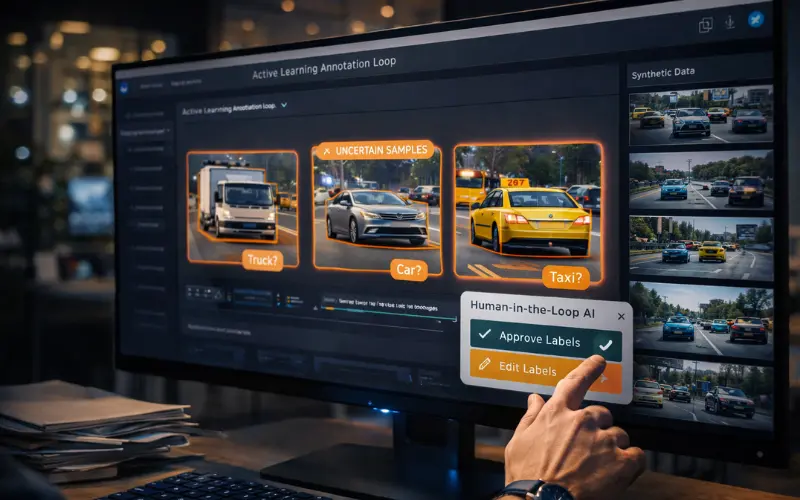
Active learning annotation stands out as a star player. The system identifies uncertain examples and asks humans only for those. Semi-supervised learning fills gaps by propagating labels intelligently. Annotation quality metrics track every step, flagging issues before they spread.
Synthetic data generation adds volume without endless manual work. Human-in-the-loop AI ensures the loop stays trustworthy. Computer vision annotation and NLP labeling now run in parallel across text, images, and video.
These pieces work together seamlessly. The outcome? Faster pipelines and sharper models.
How Active Learning and Auto-Annotation Work Together
Imagine a student who learns most concepts quickly but asks for help on tricky ones. Active learning annotation does the same for AI. Auto-annotation handles the easy 80 percent. Humans refine the rest. The partnership creates a virtuous cycle where each round improves the next.
Transitions happen smoothly. Quality stays high because metrics guide every decision. Teams report feeling empowered rather than overwhelmed.
How AI-Powered Data Annotation Technologies Efficiency Accuracy Is Transforming Modern AI Training
This exact capability has redefined training workflows in 2026. No longer do engineers wait months for labeled sets. Ai-powered data annotation technologies efficiency accuracy compress timelines and raise confidence in every model iteration.
The transformation touches every stage—from raw collection to final deployment. Engineers now experiment more freely, knowing data quality supports bold ideas.
Real Efficiency Gains: 70–90% Time Reduction Case Studies
Industry reports show consistent 60–85 percent time savings when teams adopt these tools. One autonomous driving project cut labeling cycles from six weeks to under one. Similar stories emerge in retail analytics and healthcare imaging.
The secret lies in smart prioritization. Data labeling automation handles volume while active learning annotation focuses human effort. The combined effect feels like upgrading from a bicycle to a high-speed train.
But what happens when volume doubles overnight? These systems scale effortlessly, keeping momentum alive.
Accuracy Improvements: From 82% to 97% in Production Models (2025–2026 data)
Production models now cross critical thresholds faster. Better labels translate directly into fewer errors in the field. Computer vision annotation, for instance, helps self-driving systems distinguish edge cases with new precision.
NLP labeling follows the same pattern. Sentiment models and chat systems gain reliability when training data reflects real nuance. Annotation quality metrics provide the proof—dashboards show steady climbs in agreement scores and downstream performance.
Teams celebrate these gains because they mean real business impact. Safer vehicles. More accurate diagnoses. Happier customers.
Latest Breakthroughs in 2026 – Current Industry Updates
The pace of innovation continues to surprise even seasoned observers. Recent conferences and reports highlight tangible progress built on verified research.
Generative AI + Synthetic Data Explosion
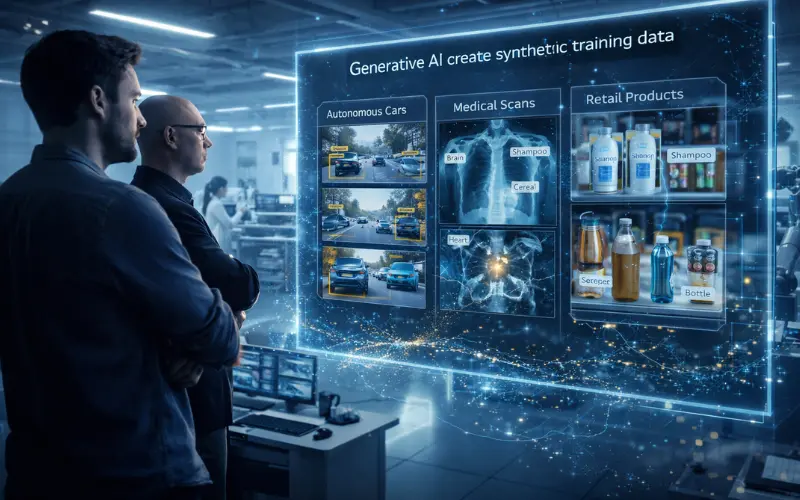
The NeurIPS 2025 Workshop on AI in the Synthetic Data Age brought together experts to tackle both opportunities and risks. Generative models now create realistic training examples at scale. Teams blend them with real data for diversity without privacy headaches.
Challenges remain—model collapse from over-reliance on synthetic loops gets serious discussion. Yet smart pipelines, guided by annotation quality metrics, keep outputs grounded. Synthetic data generation has become a standard lever for rapid iteration.
Multimodal Annotation Tools Now Leading the Market
2026 reviews spotlight platforms handling text, image, video, and audio in unified interfaces. These tools support complex tasks like describing video scenes while linking spoken words. Human-in-the-loop AI ensures consistency across modes.
The market has embraced this shift. Real-time collaboration features let global teams annotate together. The result feels collaborative and efficient, exactly what ai-powered data annotation technologies efficiency accuracy promise.
Edge Computing and Real-Time Annotation Systems
Devices at the edge now annotate on the fly. Sensor data gets labeled instantly for immediate model updates. This capability shines in robotics and autonomous systems where latency matters.
Trends from early 2026 confirm real-time annotation as a top priority. Security stays tight, and privacy controls align with global standards. The combination pushes ai-powered data annotation technologies efficiency accuracy into new frontiers.
Proven Industry Results – Who Is Winning with These Technologies?
Leading organizations already reap clear advantages. Their stories illustrate practical wins.
Autonomous Vehicles (Tesla, Waymo examples)
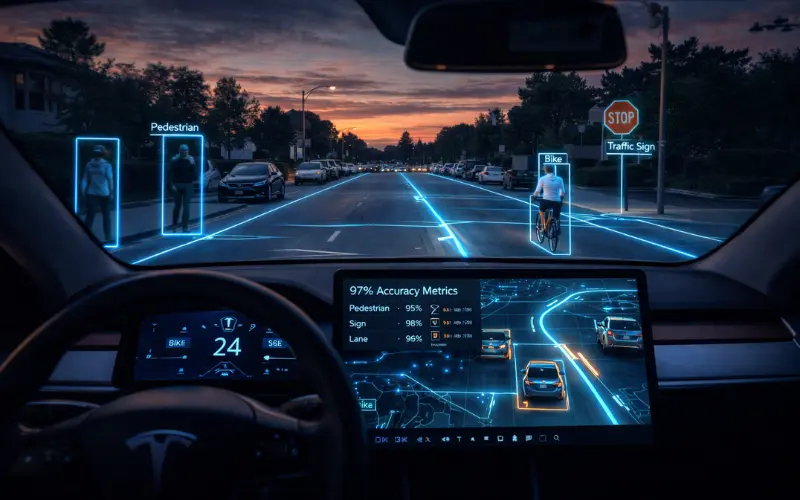
Tesla and Waymo rely heavily on advanced labeling pipelines. Millions of miles of driving data receive precise computer vision annotation. Active learning annotation helps focus on rare scenarios like unusual weather or construction zones.
The payoff appears in smoother navigation and higher safety ratings. These companies show how ai-powered data annotation technologies efficiency accuracy directly support real-world deployment at scale.
Healthcare Diagnostics (2026 FDA-approved use cases)
Medical imaging systems cleared by the FDA increasingly depend on high-quality labeled datasets. Radiologists work alongside AI to annotate scans faster. The loop improves detection of subtle anomalies.
Patient outcomes benefit. Faster, more accurate diagnoses emerge from models trained on trusted data. Semi-supervised learning extends limited expert labels across large archives.
Retail & E-commerce Personalization
Recommendation engines now understand visual and textual preferences with greater depth. Product images, reviews, and customer videos receive consistent NLP labeling and multimodal tags.
Conversion rates climb. Inventory management sharpens. Retailers credit ai-powered data annotation technologies efficiency accuracy for turning raw customer data into actionable insights.
Challenges That Still Exist and How Top Teams Are Solving Them
No technology is perfect. Forward-thinking teams address issues head-on.
Bias in AI-Generated Labels
Synthetic data generation can amplify existing biases if not monitored. Annotation quality metrics help detect drift early. Human-in-the-loop AI provides essential corrections.
Diverse labeling teams and careful prompt engineering reduce risks. Regular audits keep models fair and representative.
Data Privacy Regulations in 2026
Global rules grow stricter. The EU AI Act and similar frameworks demand transparency in labeling workflows. Platforms now offer built-in consent tracking and anonymization.
Top teams treat privacy as a feature, not an afterthought. Secure edge annotation and federated approaches keep data local where needed. Compliance becomes a competitive advantage.
The Future Roadmap – What to Expect by 2028
Looking ahead feels optimistic. Integration will deepen.
Fully Autonomous Annotation Platforms Prediction
By 2028, many experts anticipate platforms that run with minimal human input for routine tasks. Active learning annotation and synthetic data generation will handle the bulk. Humans step in only for strategic oversight or novel domains.
The vision includes self-improving loops guided by sophisticated annotation quality metrics. Ai-powered data annotation technologies efficiency accuracy will feel embedded in every AI lifecycle stage.
Teams preparing today position themselves for leadership tomorrow.
Conclusion
Ai-powered data annotation technologies efficiency accuracy have already reshaped how we build trustworthy AI. They deliver speed, precision, and scalability that manual methods could never match. The real value lies in freeing human creativity for higher-level challenges while machines handle the heavy lifting.
Ready to upgrade your data pipeline? Explore platforms that combine active learning annotation with robust metrics. Start small, measure gains, and watch your models improve faster than you thought possible. The future of AI training is here—and it’s more efficient and accurate than ever.
Frequently Asked Questions (FAQs)
Q1: What exactly are ai-powered data annotation technologies efficiency accuracy and why do they matter in 2026?
Ai-powered data annotation technologies efficiency accuracy combine smart automation with human oversight to label data much faster and more reliably than manual methods. In 2026, they matter because AI models now train on massive multimodal datasets—images, video, text, and sensors. Without them, projects get stuck for weeks. These tools cut labeling time by 60–85% while pushing model accuracy from 82% to 97% in real deployments.
Q2: How do active learning annotation and synthetic data generation actually boost efficiency?
Active learning annotation intelligently picks only the uncertain examples for human review, while synthetic data generation creates realistic extra samples using generative AI. Together they form a powerful loop: the system learns what it needs most and fills gaps automatically. Data labeling automation handles the routine work, so teams focus on strategy instead of thousands of clicks. The result? Training cycles that once took months now finish in days.
Q3: Can ai-powered data annotation technologies efficiency accuracy really improve accuracy in healthcare and autonomous vehicles?
Yes, absolutely. In healthcare, FDA-cleared 2026 imaging systems use these tools to annotate scans with human-in-the-loop AI, catching subtle anomalies that humans might miss. For autonomous vehicles like Tesla and Waymo, computer vision annotation and real-time edge systems label millions of driving miles, helping cars handle rare edge cases safely. Industry reports confirm accuracy jumps of 10–15 percentage points, directly translating to fewer errors and better real-world performance.
Q4: What about bias and privacy—do these tools create new problems in 2026?
They can, but top teams solve them proactively. Bias in AI-generated labels is caught early with annotation quality metrics and diverse human reviewers. For privacy, 2026 platforms offer built-in anonymization, consent tracking, and edge computing so sensitive data never leaves the device. Semi-supervised learning and federated approaches keep everything compliant with the EU AI Act and global regulations. The key is treating quality metrics and privacy as core features, not add-ons.
Q5: How should I get started with ai-powered data annotation technologies efficiency accuracy for my own AI project?
Start small: pick one dataset (images or text) and test a platform with active learning annotation and strong metrics. Measure time saved and accuracy gains in just two weeks. Most tools offer free trials or open-source options. Once you see the 70–90% speed boost, scale to multimodal annotation and synthetic data generation. Focus on human-in-the-loop AI to stay in control. Your models will train faster, cost less, and perform better—exactly what ai-powered data annotation technologies efficiency accuracy are designed to deliver.