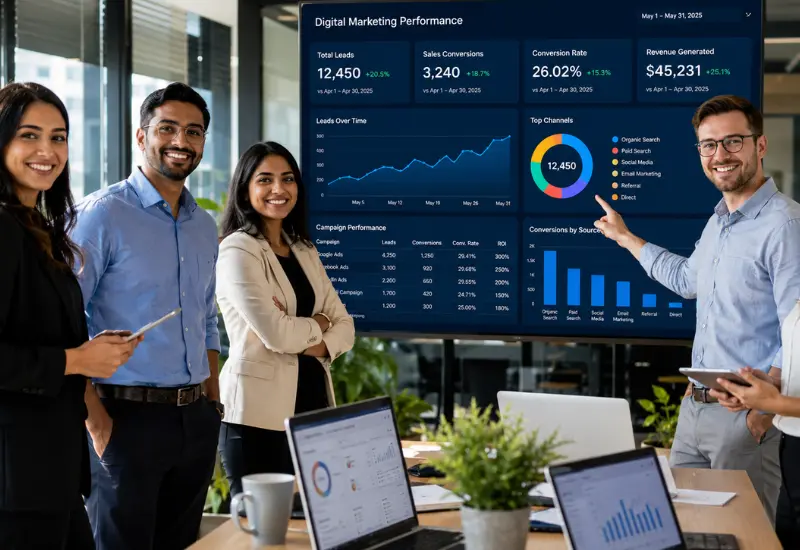
The rules of digital marketing changed faster in 2024 than in the previous five years combined. Search engines now use AI-generated summaries, third-party cookies are disappearing, and buyers are completing nearly 70% of their purchase decisions before ever speaking to a sales rep. Businesses that rely on multiple independent marketing resources rather than a unified strategy are finding it harder to compete effectively and gain clear insights into what is truly working.
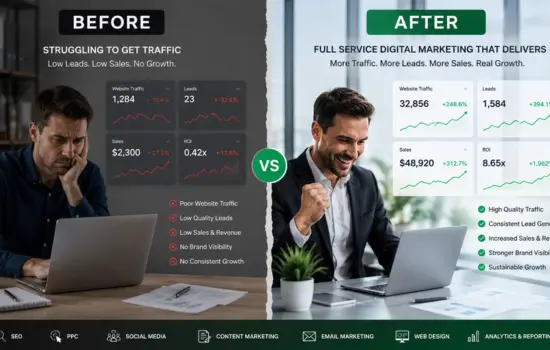
A full service digital marketing agency handles everything under one roof: SEO, paid advertising, social media, content creation, email campaigns, web development, and analytics. Rather than piecing together five separate vendor relationships, you get a unified team working from a single strategy. Every channel communicates with the others, and your data is not siloed in three different dashboards that never quite add up.
This guide breaks down what a full service digital marketing agency actually does, why more businesses are making the switch in 2025, which services matter most for lead generation and sales, and exactly what to look for when choosing the right partner. Whether you run a growing startup or a mid-sized company trying to scale, the information here will help you make a smarter decision about where to invest your marketing budget.
What Is a Full Service Digital Marketing Agency?
The term gets used loosely, so it is worth being specific. A full service digital marketing agency is a company that offers end-to-end digital marketing solutions across every major online channel. Instead of specializing in just one area, it builds, executes, and measures complete campaigns that span search, social, content, paid media, and conversion optimization — all aligned toward one business goal.
The value is not just convenience. When your SEO team, paid ads team, and content team all sit in the same agency and share the same strategy, they eliminate the gaps that kill campaigns. Keywords researched for SEO feed directly into ad copy. Blog content supports paid landing pages. Retargeting ads serve the people who read your email but did not convert. That kind of coordination is nearly impossible when you hire separately.
Core Services That Define a Full Service Agency
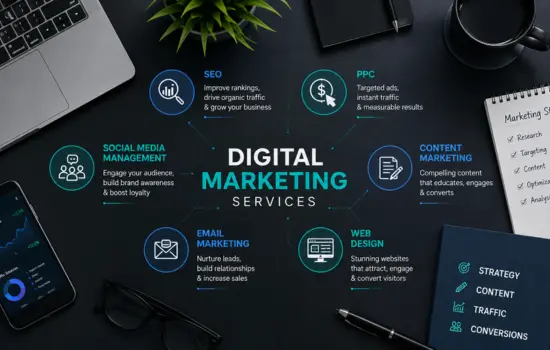
A genuine full service agency covers at least six core areas: organic search (SEO), paid search and display (PPC), social media marketing and management, content strategy and creation, email marketing and automation, and website design with conversion rate optimization (CRO). Agencies that only offer three or four of these are niche shops, even if their website says otherwise.
Beyond the core, the better agencies in 2025 also offer marketing automation setup, analytics and reporting, influencer marketing coordination, and generative engine optimization (GEO) — a newer discipline focused on appearing inside AI-generated search summaries. These additions reflect where buyer journeys are actually heading.

How It Differs From a Niche or Freelance Setup
A niche agency might be excellent at running Google Ads or producing video content, but it has no visibility into the other parts of your funnel. A freelancer might do solid SEO work, but they cannot also run your email sequences and update your landing pages at scale. The result is always the same: growth stalls because no one owns the full picture. With a full service digital marketing agency, there is one point of accountability. You have one reporting structure, one strategy meeting, and one team that can quickly pivot an underperforming channel based on what is working in another. For growing businesses, that coordination speed alone is a competitive advantage.
Why Businesses Are Choosing Full Service Digital Marketing Agencies in 2025
The full service digital marketing agency sector is one of the fastest-growing segments in the industry. According to market research, full service agencies are projected to grow at an 11.32% compound annual growth rate through 2031, outpacing specialized agencies by a wide margin. The demand signals a clear shift: businesses want integrated outcomes, not isolated deliverables.
Buyer behavior has also shifted the equation. With 68% of online journeys beginning on search engines and AI-powered search results reshaping visibility, it has become essential for SEO, content, and technical teams to collaborate closely.
is no longer optional — it is foundational. A fragmented vendor setup simply cannot respond fast enough to algorithm and platform changes.
The Real Cost of Using Multiple Disconnected Agencies
Most businesses that piece together their marketing from multiple vendors underestimate the hidden costs. There is the time spent managing three or four different agency relationships, the budget lost to overlapping ad spend and duplicate efforts, and the performance drag that comes from poor data sharing. When your SEO agency does not know what keywords your PPC agency is bidding on, you are paying for redundant traffic.
There is also the attribution problem. If your content agency drives awareness, your email agency converts the lead, and your web developer closes the loop, who gets credit? Without a shared attribution model, you cannot make smart budget decisions. Most businesses that audit this problem find they have been over-investing in the wrong channels for months.
How an Integrated Strategy Drives More ROI
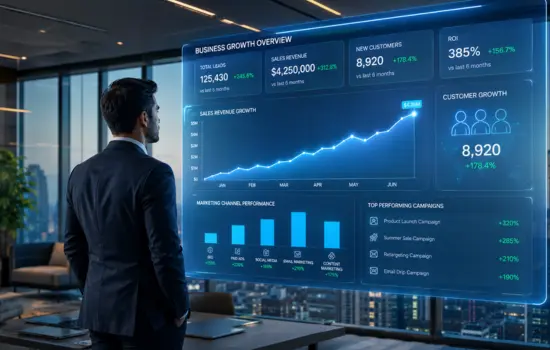
When all channels work from the same strategy, the ROI compounds. SEO content builds topical authority that reduces your PPC cost-per-click. Retargeting lists built from organic traffic convert better than cold audiences. Email sequences nurture the leads that paid campaigns attracted. Each piece makes the others more effective, and your customer acquisition cost drops over time.
The numbers bear this out. SEO alone delivers a return of over 275% on average — meaning every $1 invested yields about $2.75 back. Email marketing consistently delivers among the highest ROI of any digital channel, with returns ranging from $36 to $42 per dollar spent according to Litmus. When you combine these channels inside a coordinated strategy, the compounding effect is measurable and significant.
Key Services Offered by a Full Service Digital Marketing Agency
Understanding what you are buying matters before you sign any contract. Here is a breakdown of the core services and what each one should actually deliver for your business.
Search Engine Optimization (SEO)
SEO is the foundation of long-term organic growth. A competent agency handles technical SEO audits, on-page optimization, keyword strategy, link building, and increasingly, generative engine optimization to ensure your content shows up inside AI-powered search results. Search engines still account for 93% of all web traffic, and inbound leads from SEO have a reported 14.6% close rate — far higher than outbound channels. In 2025, SEO has expanded beyond Google rankings. Agencies now optimize for AI Overview features, featured snippets, structured data, and voice search. According to a 2025 survey of 220+ agency leaders, 73% say AI has fundamentally disrupted traditional SEO. Any agency still only talking about blue-link rankings is already behind.
Pay-Per-Click Advertising (PPC & Google Ads)
PPC delivers results fast. While SEO builds over months, a well-set-up Google Ads or Meta Ads campaign can drive qualified traffic within days. Global search ad spending reached $351.55 billion in 2026, and for good reason — PPC generates roughly $2 in revenue for every $1 spent on average, and for optimized campaigns, that number climbs considerably higher.
A strong full service agency does not just set up campaigns and let them run. It continuously tests ad copy, refines audience targeting, adjusts bidding strategies, and aligns paid keywords with organic content. PPC and SEO inform each other — the search terms that convert in paid ads often become the highest-priority targets for organic content.
Social Media Marketing & Management
Over 70% of businesses now use social media platforms to engage customers, but organic reach has become increasingly limited on most platforms. A full service agency manages both organic social and paid social — creating content, running ad campaigns, managing community interactions, and tracking performance across platforms like LinkedIn, Meta, Instagram, and X.
The strategic value of social media in 2025 goes beyond likes and followers. It drives retargeting audiences, supports brand searches, and feeds first-party data into your broader marketing funnel. Video marketing adoption has grown by 42% as a tool for brand engagement, and short-form content on platforms like Instagram Reels and TikTok now drives measurable purchase intent for 85% of viewers.
Content Marketing & Strategy
Content is the fuel that runs every other channel. Your SEO needs it, your email campaigns require it, your social media depends on it, and your landing pages are built from it. The right agency treats content as a central asset rather than an afterthought. That means a documented content strategy, editorial calendars, topic clusters, and content that matches each stage of your buyer’s journey.
The global content marketing industry reached an estimated $94 billion in revenue in 2025 and is projected to grow further. Businesses that publish consistent, high-quality content generate 3x more leads than those that do not, and at roughly 62% less cost per lead. The agencies worth working with are the ones that tie every content piece back to a measurable business outcome, not just page views.
Email Marketing & Automation
Email remains the highest-ROI channel in digital marketing. Revenue from email marketing reached $13.69 billion in 2025 and continues to climb. With an average return of $36 to $42 per dollar spent, a well-run email program is one of the most reliable revenue engines a business can build. An experienced agency does not just send newsletters — it builds automated sequences, lead nurturing workflows, behavioral triggers, and re-engagement campaigns. Automation is where most businesses leave serious money on the table. A lead who downloads a resource should automatically receive a relevant follow-up sequence. A customer who has not purchased in 90 days should trigger a win-back campaign. These workflows, when built properly, generate revenue around the clock without ongoing manual effort.
Web Design, Development & CRO
Your website is where all other marketing efforts land. If it loads slowly, converts poorly, or provides a frustrating mobile experience, even great traffic will not turn into leads. A full service agency handles both the design and the conversion side — building pages that look professional, load fast, and guide visitors toward a specific action through strategic layout, copywriting, and testing.
Conversion rate optimization (CRO) is a discipline often overlooked by businesses focused on getting more traffic. But doubling your conversion rate from 1% to 2% has the same revenue impact as doubling your traffic — at a fraction of the cost. CRO work includes A/B testing, heatmap analysis, form optimization, landing page iteration, and user experience improvements based on real data.
How a Full Service Digital Marketing Agency Generates More Leads
Lead generation is the measurable output that most businesses care about most. A dedicated digital marketing partner does not generate leads through one tactic — it builds a system where multiple channels work together to attract, educate, and convert potential customers at every stage of the buying process.
Top-of-Funnel to Bottom-of-Funnel Strategy Explained
Top-of-funnel (TOFU) is about awareness — getting in front of people who have a problem but do not yet know your brand. This is where SEO blog content, social media, and YouTube ads do their work. The goal is not a sale; it is a first impression. The right agency creates content that answers real questions your target audience is actively searching for.
Middle-of-funnel (MOFU) is where interest becomes intent. This includes lead magnets, case studies, comparison content, and email sequences that warm up prospects who already know you exist. Bottom-of-funnel (BOFU) is the conversion layer — retargeting ads, sales page copy, free consultations, and product demos that push ready buyers over the edge. An integrated agency manages all three layers without letting any one of them become a bottleneck.
Real Tactics That Convert Traffic Into Paying Customers
Effective lead generation in 2025 relies on a combination of intent targeting, personalization, and speed to follow-up. Agencies that generate real results use dynamic landing pages that match the specific ad or keyword that brought the visitor in, lead qualification forms that filter for buying intent, and CRM integrations that trigger sales team notifications the moment a high-value lead comes in.
Retargeting is one of the most underused tools in the mid-market. When a visitor reads three blog posts but does not convert, a well-structured retargeting campaign can bring them back with a specific offer tailored to the content they consumed. Businesses using retargeting report up to 70% better conversion rates compared to standard display advertising. That kind of efficiency is only possible when your agency controls both the content and the advertising.
What to Look for When Hiring a Full Service Digital Marketing Agency
The agency market is crowded, and the quality gap between providers is significant. Knowing what to look for — and what to walk away from — can save you a year of wasted budget and frustration.
Red Flags to Avoid
Be wary of any agency that guarantees specific ranking positions on Google. No legitimate agency can make that promise — search rankings depend on hundreds of variables, and anyone claiming certainty is either misleading you or selling you something manipulative. Similarly, watch out for agencies that lock all your accounts, ad profiles, and content under their own logins. Your marketing assets should always be accessible to you.
Vague reporting is another warning sign. If an agency cannot tell you specifically how many leads came from which channel, what your cost per lead was, and how that compares to last month, you are flying blind. Monthly reports should be detailed, transparent, and actionable — not just screenshots of traffic graphs. Also be cautious about agencies that pitch a large number of services in week one before they have properly audited your business.
Questions You Must Ask Before Signing a Contract
Ask how they measure success and what KPIs they track by default. Request a sample monthly performance report from one of the agency’s current clients. Ask who specifically will be managing your account — junior coordinators or senior strategists. Ask how they handle a channel that is underperforming after 90 days. And ask for two or three case studies from businesses similar to yours in size and industry. Also ask about onboarding timelines. A good agency will not promise results in 30 days. They will commit to a proper audit in the first 30 days, a strategy in the next 30, and measurable momentum by month three. Agencies that promise fast wins without a discovery process are usually skipping the work that makes those wins sustainable.
Full Service Digital Marketing Agency vs. In-House Team — What’s Better?
This is one of the most common questions growing businesses face, and the honest answer depends on your size, budget, and growth stage. Building an in-house team gives you full-time employees deeply familiar with your brand, but it also means hiring, onboarding, and retaining specialists across at least five or six disciplines — SEO, paid ads, content, email, design, and analytics. For most mid-sized companies, that is six separate hires with an annual payroll exceeding $400,000 before overhead.
An integrated agency gives you access to all of those specialists at a fraction of the cost — typically $3,000 to $15,000 per month depending on scope. You also benefit from the agency’s cross-industry experience, its existing tool stack, and its ability to scale resources up or down without the constraints of employment contracts. The trade-off is that an agency will never know your product as intimately as an in-house team does.
The most effective model for many businesses is a hybrid: one internal marketing manager who owns strategy and brand, supported by an agency that executes across channels. The internal lead provides context and institutional knowledge; the agency provides capacity and specialization. That combination often outperforms both a fully in-house setup and a fully outsourced one.
Latest Trends a Full Service Agency Should Be Using in 2025
The agencies delivering the strongest results right now are not the ones using more platforms — they are the ones using the right ones, more intelligently. These are the three areas where the best agencies are ahead of the market.
AI-Powered Marketing Tools
Artificial intelligence has moved from a buzzword to a genuine productivity layer inside high-performing agencies. AI tools are now used for keyword clustering at scale, ad copy variation testing, predictive lead scoring, and automated campaign adjustments based on real-time performance data. According to a 2025 survey, 53% of agency owners now view AI as a credible threat to traditional agency models — but the agencies embracing it are pulling ahead.
Generative engine optimization (GEO) is the newest skill on the block. As Google’s AI Overviews and tools like ChatGPT become primary discovery channels for certain queries, agencies that understand how to structure content for AI citation are earning exposure that traditional SEO rankings do not capture. Any agency that has not yet built a GEO capability is already operating with a gap in its service offering.
Short-Form Video & Omnichannel Presence
Short-form video is no longer a social media trend — it is a core performance channel. Video marketing adoption has grown 42% in the past two years, and 82% of video marketers report strong ROI from their efforts. Platforms like Instagram Reels, YouTube Shorts, and TikTok now influence buying decisions for product categories that would have been purely search-driven two years ago.
Omnichannel presence means showing up consistently across every touchpoint in your buyer’s journey — search, social, email, display, and increasingly, AI-powered recommendation surfaces. An experienced agency builds brand consistency across all of these while optimizing each channel’s performance individually. The goal is that no matter where a prospect encounters your brand, they receive a coherent, compelling message.
First-Party Data & Privacy-First Marketing
With third-party cookies largely phased out and privacy regulations tightening globally, first-party data has become the most valuable asset in your marketing stack. First-party data is the information your audience willingly gives you — email addresses, survey responses, purchase history, and on-site behavior tracked through your own analytics. Agencies that have built strong email lists, robust CRM integrations, and sophisticated website tracking for clients are not feeling the impact of cookie deprecation the way others are.
Privacy-first marketing also means investing in consent-based personalization — delivering relevant experiences to users who have opted in, rather than relying on third-party behavioral profiles. Ninety percent of consumers say they are willing to share personal data in exchange for more personalized service. The agencies building those exchange mechanisms today are the ones their clients will be thanking in three years.
How to Measure the Success of Your Digital Marketing Agency
Accountability separates average agencies from great ones. Knowing which metrics to track — and what good looks like — puts you in a much stronger position as a client. You should be able to walk into any review meeting and clearly understand whether your investment is generating a return.
KPIs That Actually Matter
The metrics that matter most for most businesses are cost per lead (CPL), lead-to-customer conversion rate, customer acquisition cost (CAC), and monthly recurring revenue influenced by marketing. According to HubSpot’s 2025 State of Marketing data, marketers in 2026 are prioritizing lead quality and marketing qualified leads (MQLs) at 39%, followed by lead-to-customer conversion at 34%, and overall marketing ROI at 31%.
Vanity metrics — total website visitors, social media followers, email open rates — can tell part of the story, but they should never be the headline. An agency reporting only on traffic and impressions while avoiding conversations about leads and revenue is deflecting accountability. Push for reporting that connects channel performance directly to pipeline activity.
Monthly Reporting Standards You Should Expect
A professional agency should deliver a monthly report that covers performance across every active channel, with clear comparisons to the previous period and to agreed targets. It should include an executive summary written in plain language, not just data tables. It should explain what worked, what did not, and what the team is changing as a result. A good report takes about 15 minutes to read and leaves you with zero confusion about the state of your campaigns.

You should also receive access to a live dashboard — not just a monthly PDF. Tools like Google Looker Studio, AgencyAnalytics, or custom reporting setups give you real-time visibility without waiting for a monthly call. If an agency resists giving you ongoing access to your own data, treat that as a serious red flag about transparency.
Conclusion
Growing a business through digital marketing in 2025 requires more than running ads or publishing blog posts. It requires a connected strategy where every channel reinforces the others, every decision is driven by clean data, and every effort maps back to revenue. The right agency partner brings that integration, that accountability, and that cross-channel expertise without the overhead of building it yourself. The businesses gaining ground right now are the ones that stopped treating marketing as a collection of tasks and started treating it as a growth system. If you are ready to work with a full service digital marketing agency that delivers real results, now is the time to take that step.